The Defining AI Product Manager Skills in 2026: Moving Beyond the Spec
As organizational expectations accelerate, the traditional method of writing static technical requirements and hoping the engineering team interprets the logic correctly is fading. Instead, product teams are actively testing new ways to build, validate, and align around complex, generative interfaces.
Success requires shifting away from purely administrative backlog management toward hands-on, logic-driven orchestration. Navigating this transition means mastering rapid prototyping, understanding probabilistic systems, and driving faster stakeholder alignment to turn raw model capabilities into tangible user experiences.
Machine Learning for Product Managers: The New Baseline
Managing machine learning products requires a solid grasp of data dependencies, model constraints, and rapid prototyping tools to validate probabilistic outcomes before engineering writes production code on platforms like AWS SageMaker or Google Vertex AI.
Many product teams struggle because they treat machine learning features like traditional, deterministic software. However, standard product requirements documents (PRDs) fail to capture the inherent variance of AI outputs. There is no singular "happy path" when a large language model shapes the user experience; an iterative, experimental mindset is mandatory.
PMs don't need to write PyTorch code or configure complex Kubernetes clusters, but they do need to understand how to surface predictions intuitively. While heavy MLOps platforms like Databricks or MLflow are essential for production environments, they are often far too slow for early-stage product discovery.
Industry research on product management trends, shows that the defining skill today is rapid experimentation. Teams need a workflow that allows them to bring a concept into a workspace, tweak prompt behaviors, and test interface interactions immediately. As product analyst Aakash Gupta noted, AI prototyping has fundamentally shifted how PMs operate, bridging the gap between raw backend capabilities and actual user experiences.
Bridging Data Science and User Experience
Connecting data science predictions to actual user workflows means prioritizing clarity and designing fallback states for low-confidence results or hallucinations.
While data scientists naturally optimize for abstract accuracy and recall metrics, PMs must optimize for usability and trust. In practical terms, this means anticipating exactly where a model might fail or return an anomalous result.
Too much time is often wasted arguing over statistical metrics instead of testing live user flows. Building functional representations early shows how real users react when a recommendation misses the mark or requires manual correction, ensuring the technology serves a clear, measurable customer need.
Distinguishing Between Production Models and Prototyping
Production frameworks handle massive data pipelines and model serving, whereas prototyping environments focus on simulating user interactions and validating core assumptions quickly before entering full development.
PMs don't need to master Vertex AI or Azure ML to design great AI features - the true goal is mastering the validation loop, not becoming a junior data scientist.
Separating prototyping from production allows teams to deploy significantly faster. Testing complex concepts in lightweight environments lets organizations gather behavioral feedback safely. Once the interaction model is proven, the validated logic can be handed off to engineering to build the robust, scalable pipelines required for production.

Managing Feature Toggles and Revisions
Feature toggles allow teams to deploy AI models behind controlled switches to measure real-world impact and mitigate risk before a full release.
Because predictive algorithms often require adjustment after encountering live traffic, PMs need strict rollout strategies to limit exposure if a model drifts from its intended behavior. Using A/B testing frameworks helps compare the new intelligent feature against legacy workflows. Protecting the user experience requires combining thorough early-stage testing with reliable feature flags during final deployment.
Next-Gen AI Product Management: Shifting Toolchains
Modern AI product management relies less on static specification documents and isolated mockups, moving instead toward interactive workspaces where logic, interface design, and prompt behaviors can be tested simultaneously.
As organizations flatten reporting structures, PMs are carrying more direct responsibility for the final output, as highlighted in recent insights on AI skills for product managers. Static design files rarely suffice for demonstrating complex, generative behaviors.
When comparing static diagramming against interactive prototyping, the difference in team comprehension is striking. Explaining verbally how an AI agent will summarize a document pales in comparison to showing an interactive prototype that actively processes sample text. Operating in environments that generate immediate, functional visual representations of logic shortens feedback cycles and validates complex ideas without exhausting engineering resources.
Moving From Wireframes to High-Fidelity Logic
Moving to high-fidelity logic means building prototypes that simulate dynamic AI outputs and real data interactions, shifting the focus from visual layouts to functional validation.
Traditional wireframes focused on fixed clicks and predetermined static screens, but modern product management workflows require interfaces to react dynamically to fluid user context.
While static tools like Figma excel at layout design, they struggle to convey the probabilistic nature of AI content blocks. Building prototypes with functional underlying logic allows stakeholders to interact with realistic scenarios, ensuring development teams receive specifications rooted in tested interaction patterns rather than guesswork.
Prompt Engineering as a Structural Discipline
Treating prompts as foundational product features requires PMs to version-control logic, test phrasing against edge cases, and measure response reliability.
Writing effective system instructions is a core product competency, not a casual side task, because the underlying prompt directly shapes the final experience.
Unstructured, ad-hoc prompt testing invariably leads to highly inconsistent product behavior. Prompt evaluation demands the same technical discipline applied to traditional software unit tests. Establishing a rigorous evaluation routine around system instructions allows teams to embed AI functionalities with confidence.
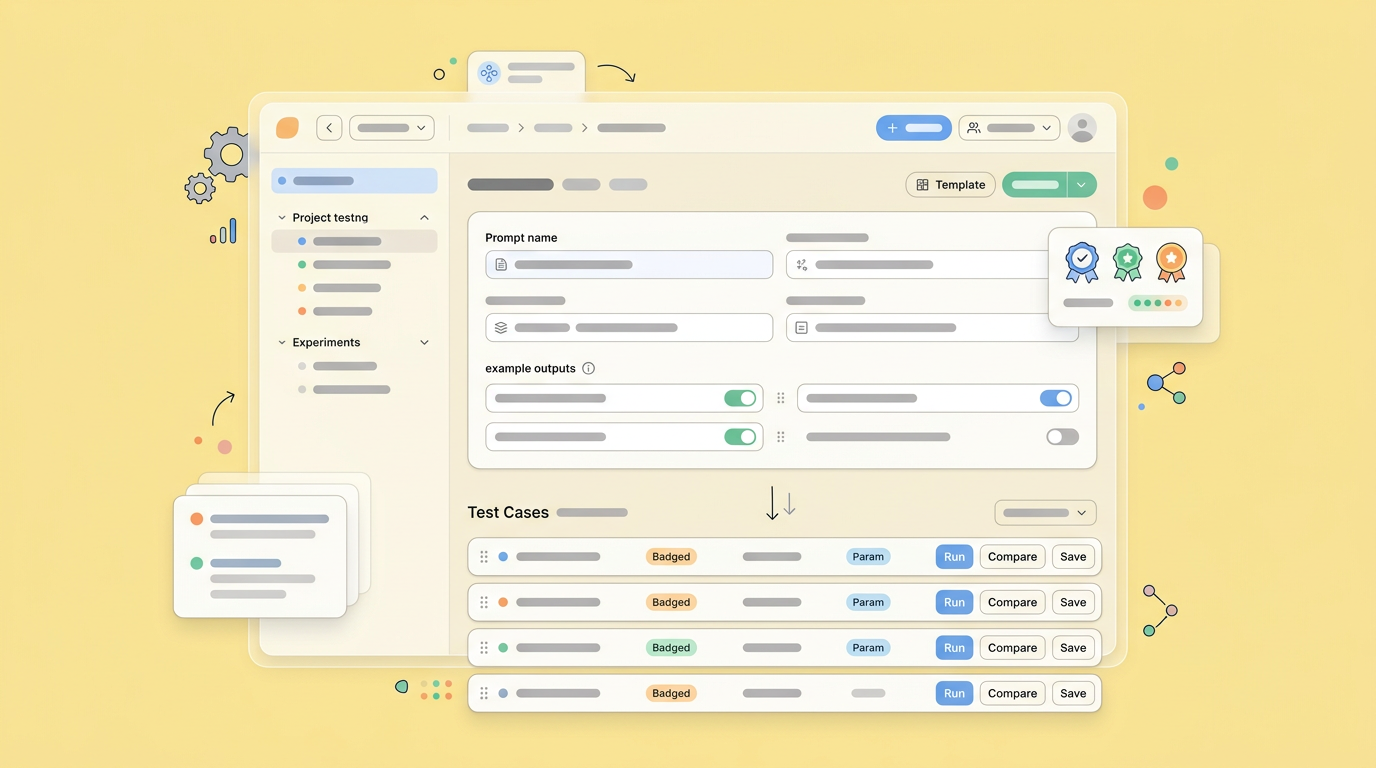
Essential AI Product Management Competencies
Core AI competencies require learning how to manage probabilistic edge cases, translate fluid interactions into structured specs, and facilitate rapid stakeholder alignment through tangible demonstrations.
Traditional software yields predictable results from specific queries, but generative models break this paradigm completely. The critical shift for experienced product builders is moving from a mindset of absolute control to one of careful orchestration.
High-performing teams excel at testing these architectural boundaries early. What happens when a model generates an error? How does the interface handle unexpected latency? Resolving these structural questions before handing off final requirements prevents friction down the line.
Handling Probabilistic Edge Cases
Managing edge cases requires defining clear safety boundaries, establishing fallback UI states, and continuously refining system instructions to keep hallucinations from reaching the end user.
Trust degrades rapidly when an AI model breaks a layout or generates unexpected output, meaning these edge cases must be actively anticipated during the initial design phase. Intentionally trying to break the system's logic during internal testing exposes these vulnerabilities early, building structural resilience and preserving user trust even when the technology encounters unfamiliar data inputs.
Accelerating Stakeholder Alignment
Alignment happens when long, speculative meetings are replaced with interactive sessions where prototypes can be manipulated and critiqued in real time, drastically reducing organizational ambiguity.
Because executives and engineering leads struggle to conceptualize AI behavior from text descriptions alone, testing and validating product concepts fast comes down to immediate, tangible demonstration. As product design expert Christopher Nguyen emphasizes, introducing product context early and sharing functional artifacts eliminates abstract debates and aligns teams instantly.
Upskilling for AI Product Managers in 2026
Upskilling requires embracing experimental workspaces, understanding foundational LLM mechanics, and adopting frameworks that allow for iterative testing without writing backend code.
While an advanced computer science degree isn't mandatory, deep tool fluency is. The market now expects PMs to move from simply managing Jira tickets to actively participating in the functional building phase. PM educator Tal Raviv highlights how teams are even pulling intelligent agents into strategy sessions to mock up solutions live while discussing the overarching problem.
Testing, Measuring, and Growing Smarter
Continuous learning requires clear success metrics for AI interactions, measuring task completion alongside user sentiment and factual accuracy.
Evaluating an intelligent feature goes far beyond traditional clicks and engagement tracking. Teams need specific analytics tied to output quality - such as how often users accept, modify, or reject a generated suggestion. This data directly informs the next iteration of the underlying prompt, creating a feedback loop that continuously refines performance based on true user intent.
Navigating the Prototyping Ecosystem
Navigating this ecosystem means balancing heavy engineering frameworks against flexible ideation workspaces, choosing tools that empower teams to iterate on logic before requesting developer intervention.
The sheer volume of options can cause analysis paralysis, but as academic insights on product management evolution show, selecting the right platform directly determines a team's velocity. The ideal toolchain allows a product manager to maintain ownership of the initial vision while producing structured, dependable outputs that developers can readily implement.
Beyond the Spec: Validating Through Action
Realizing the value of modern AI product management means closing the gap between concept and hand-off by establishing reliable, interactive representations of the feature.
Ultimately, developing these core skills comes down to execution speed and precision, moving teams toward faster, more definitive architectural decisions. Interactive, hands-on reviews help product teams completely bypass the costly misunderstandings that frequently stall software development.
The goal is to move past explaining what an interface should theoretically do and instead demonstrate exactly how it behaves. Keeping cross-functional teams aligned from the first conceptual spark all the way to a hand-off ready prototype ensures the transition from abstract idea to deployed code remains clear, efficient, and actionable.
You and your team can refine these essential probabilistic design skills by signing up for Dazl to build your prototype.
Get Started