Stop Starting Over: A Better Miro Alternative for Product Managers
The belief goes something like this: product discovery belongs on a massive, unstructured digital canvas, and prototyping belongs in a dedicated design tool. According to this model, the product manager’s job is to herd stakeholders into the whiteboard for brainstorming, painstakingly extract the winning ideas, and then manually rebuild those concepts as wireframes elsewhere.
We accept the friction between these two stages as a permanent reality of building software. We assume that losing some context during the handoff is just the cost of doing business.
This separation forces product managers to act as human translation layers. You spend days mapping out user journeys and clustering insights, only to start from a blank screen the moment you need to show how the interface will actually behave. The best tool for product strategy shouldn't force you to leave your research behind when you start building.
When evaluating a Miro alternative for product managers, the goal isn't finding a slightly better collection of virtual sticky notes. The goal is finding a workflow that carries your initial research directly into a clickable prototype, keeping your team aligned without constantly resetting the project state.
The Friction Between the Canvas and the Prototype
The biggest drop-off in product momentum happens exactly when you try to translate a whiteboard map into a functional prototype. A whiteboard is excellent for capturing abstract thoughts, yet it offers zero scaffolding for building a realistic interface.
In our testing with mid-market product teams, we found that product managers often spend substantial time re-entering information they already gathered. You map a complex user flow using arrows and boxes, and then you have to recreate that exact flow in a completely different environment. According to a recent report, Miro boards don't transfer cleanly to other tools, meaning the sticky notes, frames, and connections remain locked in that specific format.
This disconnect creates a massive vulnerability for the project. Every time you switch environments, you leave behind the nuances of the initial discussion. Every time you switch environments, you leave behind the nuances of the initial discussion. This includes:
- Contextual comments
- Rejected ideas
- Raw user feedback
The Cost of Rebuilding Context
Context switching between abstract ideation tools and rigid design tools drains momentum and introduces critical misalignments. When you rebuild a concept from scratch, the original intent often gets diluted.
Research from the American Psychological Association highlights that context switching can consume up to 40% of our productive time. For a product manager, this manifests as:
- Hours spent writing detailed Jira tickets to explain whiteboard sticky notes.
- Visual logic from workshops rarely surviving the journey to the wireframe.
Teams frequently report that stakeholders approve a high-level user journey on a canvas, only to reject the resulting prototype because it "doesn't feel like what we discussed." The problem isn't the design; the problem is the missing connective tissue between the abstract idea and the concrete execution.
Why Pure Whiteboards Stall Execution
A pure whiteboard optimizes for divergent thinking at the expense of convergent action. It encourages infinite expansion without offering a structured path toward shipping software.
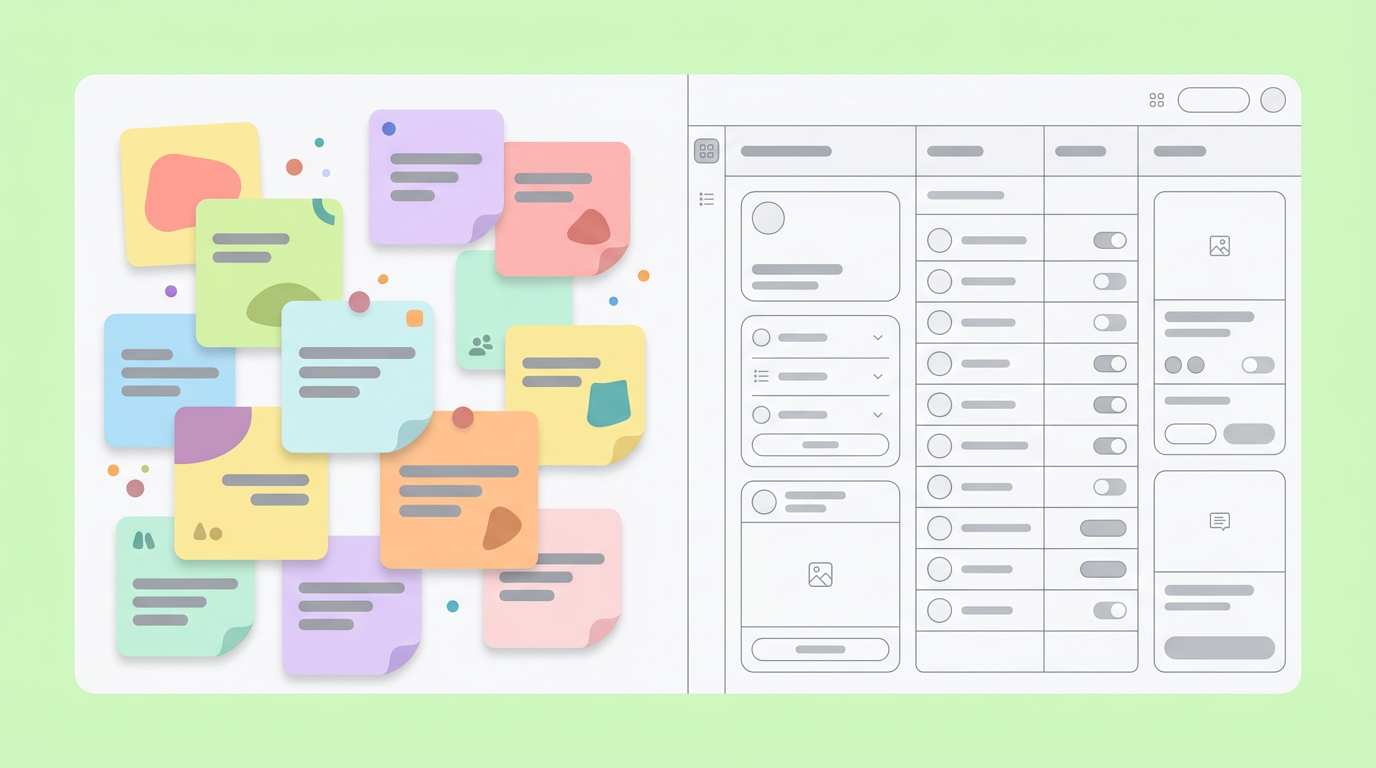
While infinite canvases are great for generating ideas, they actively hinder the transition to structured product development. According to industry reviews, relying solely on unstructured visual tools can delay the roadmap. The lack of constraints means that every interface element has to be imagined and drawn from scratch.
When product teams evaluate visual collaboration tools for product management, they often look for better drawing capabilities. What they actually need is a bridge to execution. As we've seen, a tool that stops at the ideation phase forces the product manager to manage the gap manually.
Rethinking Visual Collaboration Tools for Product Management
Modern product discovery requires an environment where the research artifacts and the interactive prototypes coexist. Visual collaboration must extend beyond static diagrams and evolve into living product specifications.
The traditional workflow assumes that product discovery ends the moment prototyping begins. We challenge this assumption entirely. Discovery is an ongoing process that frequently overlaps with prototyping. As you build a clickable model of the interface, you invariably uncover new edge cases that require returning to the foundational research.
If your research lives in one tool and your prototypes live in another, you cannot iterate effectively. A true Miro alternative for product managers integrates the structured data of user research with the interactive components needed for prototyping. You need an environment like Dazl that serves as the PM's teammate from ideation and spec writing through a hand-off ready prototype, keeping the whole team aligned.
Integrating Machine Learning Workflows
Building interfaces for machine learning products requires tightly coupling the user experience with underlying data models. A basic whiteboard cannot capture the complexity of dynamic AI outputs.
When product managers design machine learning features, they face unique challenges in visualizing how the model will behave. You cannot represent variable confidence scores or dynamic content generation with static sticky notes. The workflow requires prototyping tools that can simulate data variations and edge cases.
From our observations, these teams urgently need to visualize the logic flow of the data, which demands a prototyping environment that supports complex state changes and dynamic inputs.
Consolidating the Discovery Stack
Consolidating your discovery stack reduces administrative overhead and keeps the product narrative intact. By keeping research and prototyping in the same environment, you eliminate the need to synchronize updates across multiple platforms.
A study by Forrester indicates that improving cross-functional alignment can accelerate time-to-market. When the user research, the technical constraints, and the interactive prototype share a single source of truth, engineering teams gain immediate clarity. They can:
- Click on a component in the prototype.
- Immediately read the user interview snippet that justified its placement.
This unified approach fundamentally changes how product managers run reviews. Instead of navigating between a presentation deck, a whiteboard, and a design file, you present a cohesive narrative where the problem and the proposed solution live side by side.
Moving From Research to Clickable Prototypes
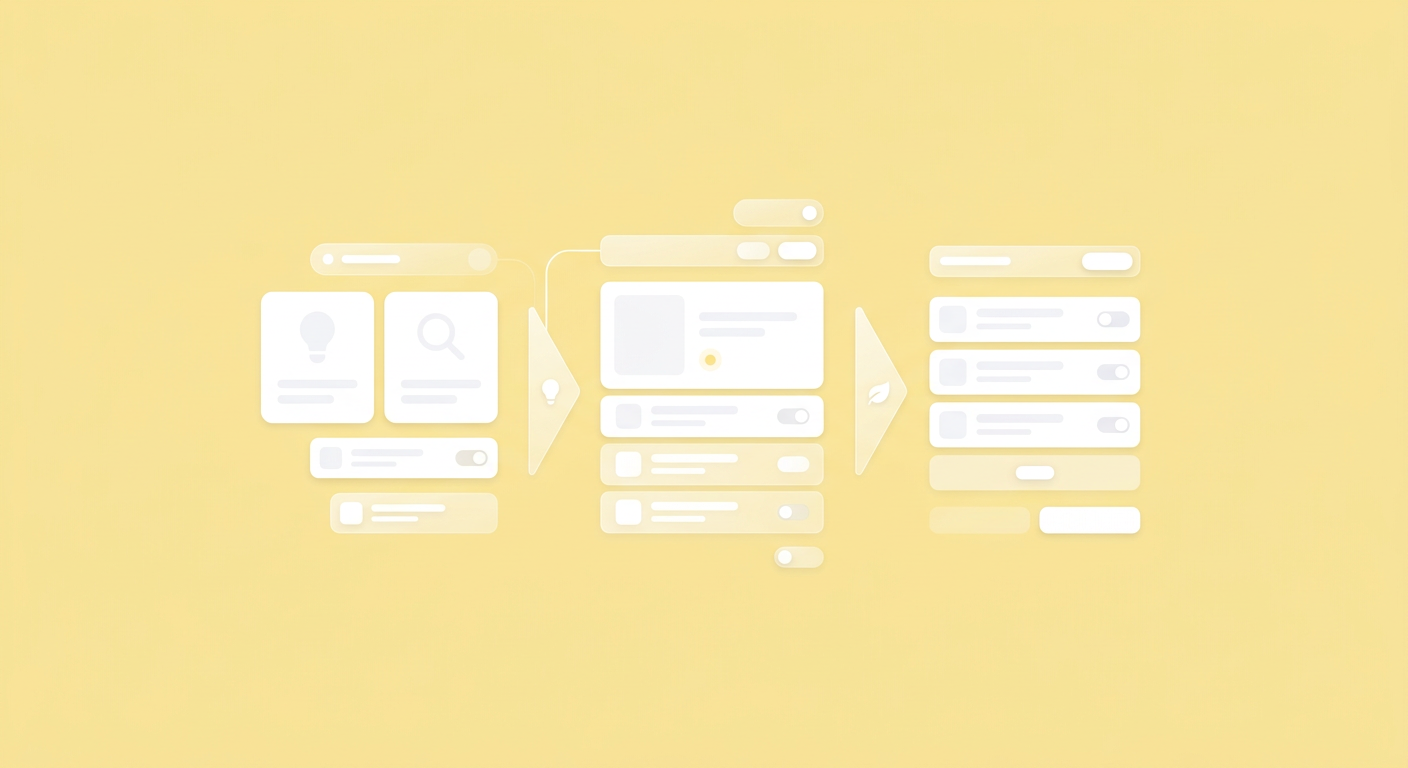
Transitioning from abstract research to a clickable prototype should feel like a continuous evolution of the same document, not a hard reset. The goal is to incrementally add fidelity to your initial ideas.
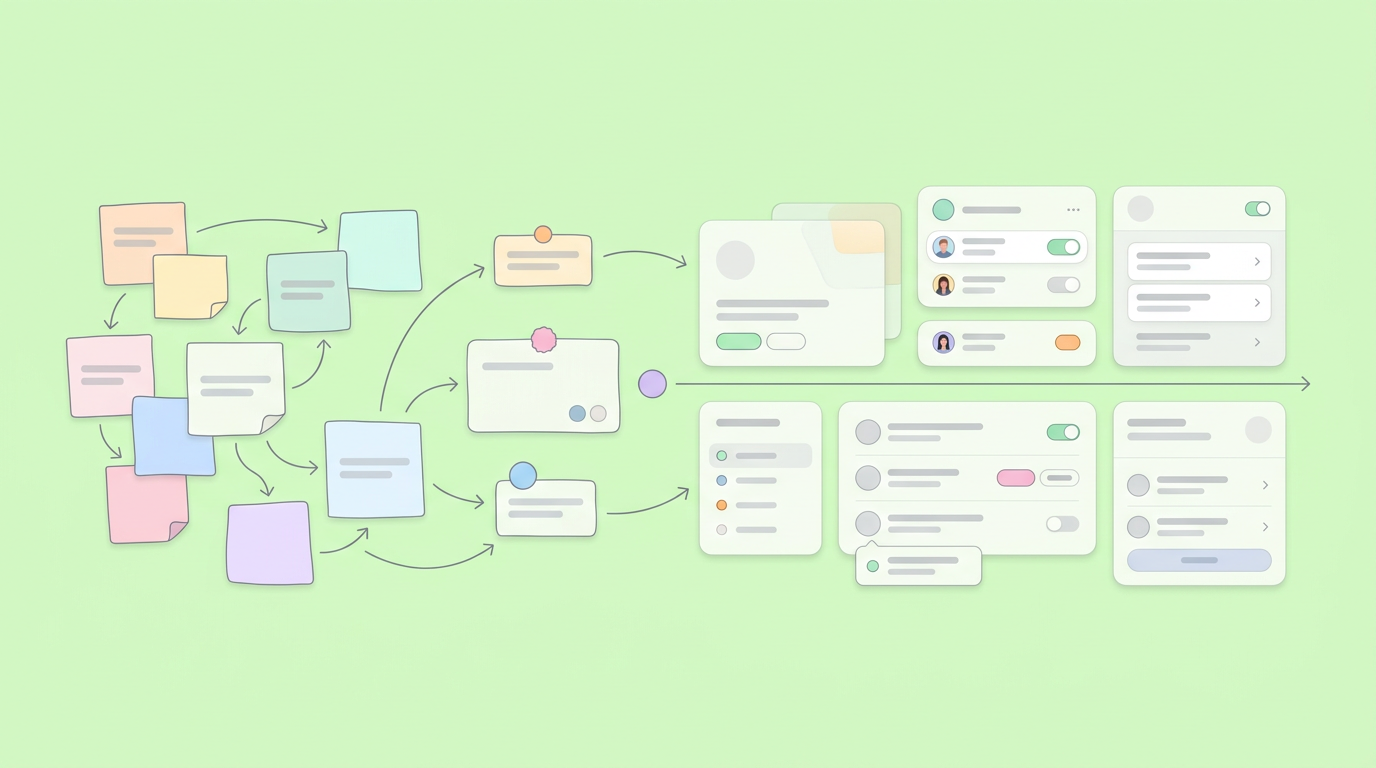
Instead of starting with a blank design file, you should be able to group your insights and immediately convert those clusters into interface components. This progressive enhancement ensures that every element in the prototype maps directly back to a validated user need.
To achieve this, product teams need to adopt tools that understand the language of interface design. A standard online whiteboard sees a square as just a collection of pixels; a dedicated product workspace understands that the square represents a functional button or a data container.
Preserving Stakeholder Alignment
Stakeholders lose confidence when they cannot draw a straight line from the strategy meeting to the final prototype. Maintaining that lineage is crucial for securing early buy-in.
When stakeholders see the prototype evolving directly from the collaborative canvas, they feel more ownership over the solution. They can see how their feedback during the ideation phase directly influenced the interactive model. According to industry guides, maintaining this visual connection helps turn brainstorms into stakeholder-ready repositories.
This transparency reduces the friction during design reviews. You spend less time defending the prototype because the rationale is embedded right next to the interface elements. The conversation shifts from "Why did we build this?" to "How can we improve this flow?"
Accelerating the Path to Engineering
Providing engineering with a prototype that retains its discovery context drastically reduces development rework. Engineers need to understand the "why" just as much as the "what."
According to Nielsen Norman Group, fixing a usability problem after launch can cost up to 100 times more than fixing it during design. By delivering a prototype that includes the foundational research and logic flows, product managers help engineers anticipate edge cases before they start coding.
We find that teams moving from unified discovery environments to their issue trackers - like Linear or Jira - create much clearer tickets. The prototype serves as a comprehensive spec, reducing the back-and-forth clarification cycles that typically plague sprint planning. If you want to dive deeper into connecting discovery to technical execution, read more on Bridging the Gap: From Product Discovery to Clickable Prototype.
Shifting Focus to High-Fidelity Execution
The next phase of product management tooling will entirely dissolve the boundary between mapping an idea and experiencing it. We are moving toward a future where the canvas itself becomes the prototype.
As product managers face increasing pressure to deliver validated concepts faster, the tolerance for manual transcription between tools will disappear. The expectation will be that defining a user flow visually automatically generates the foundational structure of the interface. This shift forces us to reevaluate every tool in our stack, asking how well it captures ideas, but how quickly it tests them.
The most effective product teams are already treating their discovery artifacts as living prototypes. They understand that an idea is only as valuable as the speed at which it can be validated. By demanding more from our discovery environments, we shorten the distance between a raw insight and a tangible product experience, delivering better solutions with significantly less administrative drag. For teams looking to eliminate context loss entirely, exploring how to unify feedback is the critical next step. You can read more about this in our guide on Why Your Stakeholder Feedback Is Scattered (And How to Unify It).
You and your team can preserve your momentum by joining Dazl to turn your visual ideas into functional product prototypes today.
Get Started