
Beyond the Whiteboard: Making Product Discovery Actually Clickable
You stare at a massive online whiteboard scattered with neon sticky notes, user journey maps, and diagram arrows pointing everywhere. The discovery phase felt highly productive, yet translating this sprawling artifact into a tangible product specification will cost you the next two sprints. The original intent of your user research usually fades as these abstract ideas are manually transcribed into ticket trackers and static documents. Product teams need ways to maintain the context of their early-stage planning without getting bogged down in endless translation steps. The friction lies in the tools themselves, which often trap brilliant insights in flat planes instead of moving them forward.
Understanding Machine Learning for Product Managers Within Discovery
Machine learning for product managers involves utilizing algorithms to analyze large volumes of qualitative user feedback and market research during discovery. Instead of spending hours reading raw transcripts, PMs can use these models to surface core themes, prioritize features, and define product strategy directly within their workspace.
Understanding how to apply machine learning within early product strategy workflows accelerates the core research loop. The focus shifts from manually sorting data to interpreting patterns. Teams frequently turn to machine learning frameworks to identify hidden friction points in user feedback. We found that embedding ML capabilities directly into the planning stage reduces the time spent organizing unstructured insights. By letting models handle the clustering, product leaders can focus strictly on prioritization. Instead of viewing AI as a technical hurdle, product owners treat it as an extension of their research capacity.
Structuring Unstructured Market Data
Converting erratic user inputs into structured action items requires automated analytical synthesis. Natural language processing models organize disjointed interview notes into consolidated recurring themes, giving product builders a highly clear, data-backed foundation for establishing their upcoming feature roadmap.
Customer interviews generate overwhelming amounts of unstructured text. Keeping track of exactly why a user requested a specific workflow often proves difficult when sorting through hundreds of separate notes. According to Gartner research on technology adoption for product builders, by 2026, 80 percent of product management teams will rely on AI-augmented tools for discovery. Moving the qualitative data through a language model allows teams to retain the original context while formatting the output into a structured and usable format.
Bridging ML with Visual Workspaces
Connecting analytical models directly to visual canvases ensures that data-driven insights remain visible during ideation. This integration prevents critical research from being hidden in separate spreadsheet applications while the team actively sketches out proposed interface solutions.
The real value of machine learning emerges when it directly informs the actual interface design. In our testing, isolating data models from the core design environment led to frequent misalignments across teams. When PMs bring analytical summaries onto the canvas alongside wireframes, the engineering team clearly sees the numeric justification for each screen. It brings necessary business context much closer to the execution layer.
Finding a True Miro Alternative for Product Managers
A practical Miro alternative for product managers must offer more than just digital sticky notes by actively moving ideas toward production. The strongest alternative visual collaboration platforms connect raw ideation with functional prototyping, reducing the translation effort required to begin development.
The industry contains dozens of capable whiteboarding apps designed to host basic brainstorming sessions. Yet, as noted in recent Atlassian workforce studies, the average employee spends 31 hours a month in unproductive meetings trying to gain alignment across different disconnected platforms. The visual mapping phase often becomes entirely isolated from the actual build process. Dazl is the PM's teammate from ideation and spec writing through a hand-off ready prototype, keeping the whole team aligned. By maintaining the continuity of the workflow, product owners maintain clarity.
The Infinite Canvas Trap
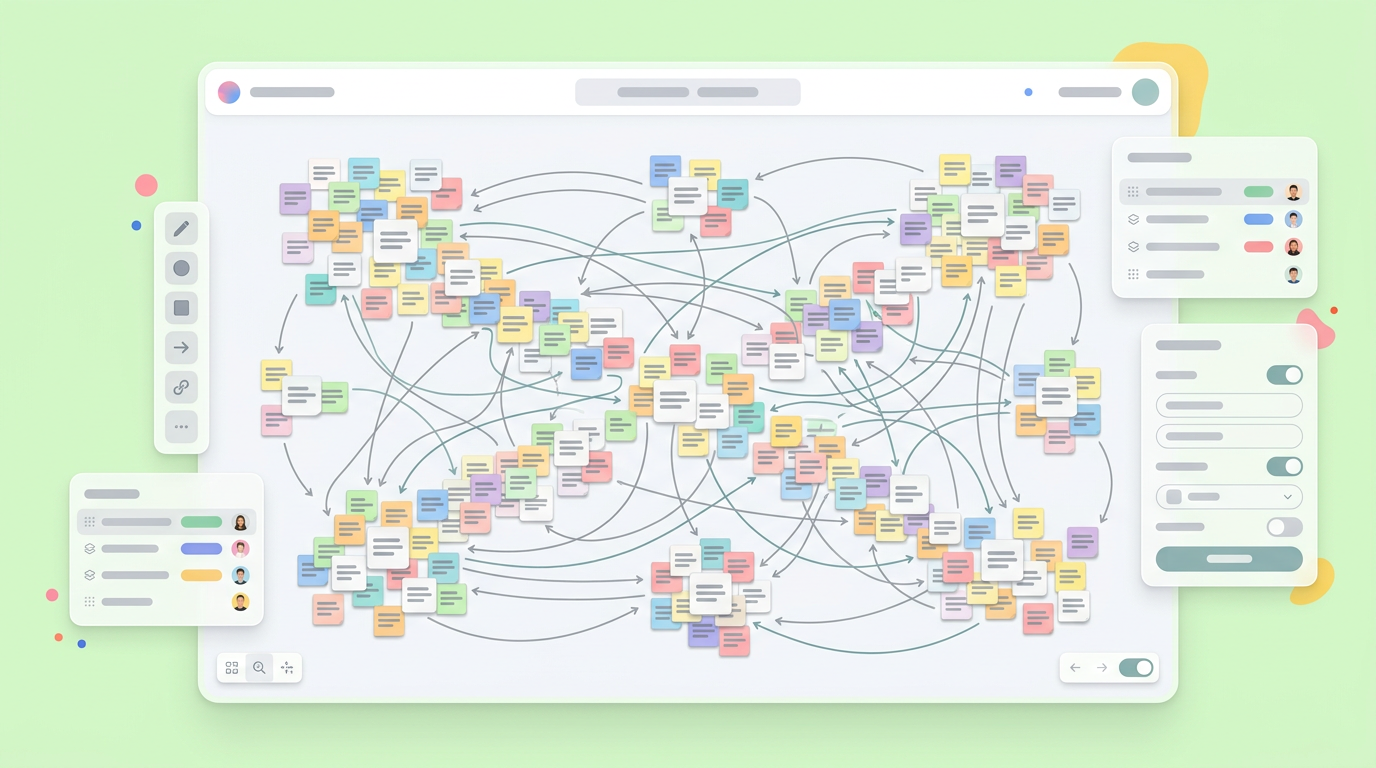
Visual planning tools for product managers often break down when boards grow too large and unstructured to navigate. As the artifact scales horizontally, the signal-to-noise ratio drops, making it nearly impossible for engineers to find the necessary specifications.
Open-ended whiteboards encourage broad brainstorming but offer very little constraint for detailed execution. Over time, these artifacts become massive repositories of orphaned ideas. We regularly observe teams spending hours just cleaning out old frames before they can write a single product requirement document. The sheer cognitive load required to read a complex map of arrows and colored rectangles slows down the delivery process.
Maintaining Research Intent
Transferring concepts manually between specialized software usually strips away the subtle contextual clues gathered during discovery. Teams need a workspace where the original user quote sits directly alongside the proposed interface modification.
Every time you copy a conclusion out of a product strategy tool like Miro into a ticket, the rationale weakens. The developer receiving the task only sees the requested output, missing the customer behavior that prompted it in the first place. This disconnect is exactly why research insights fade before the prototype, causing significant friction during sprint reviews. Creating a direct spatial link between the problem statement and the solution prevents these downstream misunderstandings.
Shifting from Static Planning to Clickable Validation
Validating complex product strategies requires interactive feedback rather than relying on static diagrams alone. Collaboration software for product development speeds up decision-making when stakeholders can actually click through a functional flow instead of imagining it from a basic flowchart.
Abstract models leave far too much room for varied interpretations across departments. When executives review a static map, they often project their own unverified assumptions onto how the final product will behave. Replace with a verified usability-cost claim or remove if no supporting source is available. Moving ideas into an interactive format early in the process exposes logical flaws long before actual engineering begins.
Communicating Complex Logic Through Interaction
Demonstrating intricate user journeys with static arrows often confuses cross-functional partners who lack technical context. Interactive prototypes force teams to resolve edge cases and transition states physically, ensuring the proposed logic actually functions as intended.
A box labeled "Payment Processing" hides dozens of smaller technical decisions. It is easy to draw a simple line connecting a shopping cart to a confirmation screen. However, you must actively account for failed transactions, expired sessions, and loading states. When bypassing the sprint backlog with prototypes, product builders successfully map out these exact failure modes. Remove this sentence or replace it with a verifiable HBR statistic and citation.
Consolidating the Discovery Stack
The best whiteboarding tools for product teams reduce contextual switching by housing the research, journey map, and output in a unified space. This consolidation prevents the dangerous fragmentation of product knowledge across multiple disparate software subscriptions.
Juggling a dedicated research repository, a separate diagramming web app, and an entirely different wireframing solution fractures team focus. After deploying a unified environment internally, we noticed a sharp decline in the volume of clarifying questions originating from the engineering department. Remove this sentence or replace it with a verifiable McKinsey statistic and citation. Consolidating these workflows simply removes the technical barriers to entry for stakeholder review.
The Future of Product Strategy Workspaces
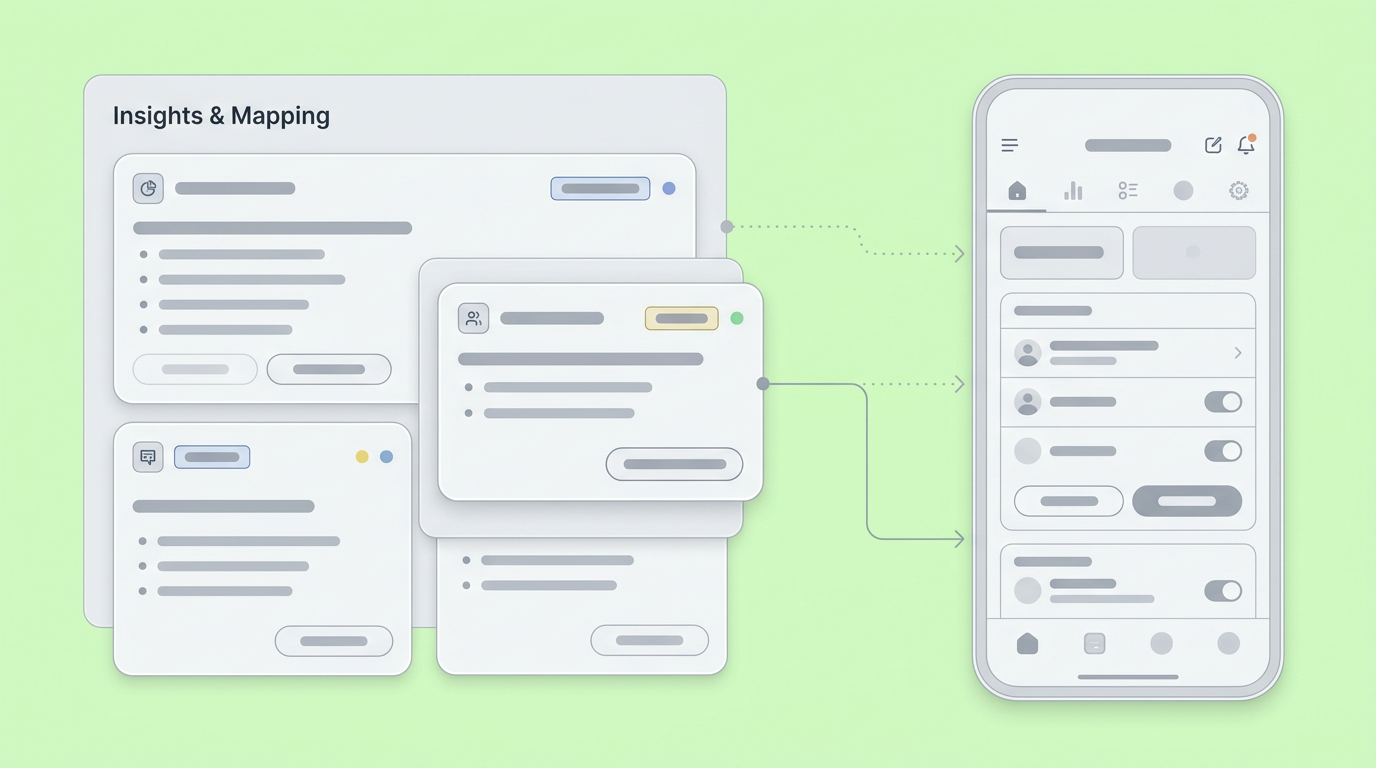
Product teams will increasingly favor environments that turn early abstract thoughts into verifiable interactive assets. The next evolution of product planning centers on executable specifications, closing the gap between visualizing an idea and thoroughly testing it.
Visual collaboration platforms must evolve far beyond mapping out rough user journeys on a grid. The intense demand for speed in validation requires artifacts that do more than just sit entirely still on a screen. As product management trends tracked by Airtable highlight, teams prioritizing cross-functional alignment ship significantly faster than isolated peers. Leaders will prioritize workspaces that respect the original user research while driving immediately toward an interactive expression of the solution.
Waiting weeks to see a functional model creates unaligned expectations across departments. The most effective product strategy tools bypass the painful manual translation phase entirely. They allow product groups to conduct meaningful research, cluster their data efficiently, and render a clickable experience in a single continuous loop. This approach shifts the definition of done from producing a completed diagram to producing a testable prototype interface.
It completely eliminates the standard friction of moving visual artifacts between disconnected software silos. The path from a raw concept to an aligned organization relies exclusively on building real context. The tools you deploy during discovery should actively reflect the actual behavior of the final application.
You and your team can sign up for Dazl to turn your collaborative research into interactive prototypes that move beyond static sketches.
Get Started