
Mastering the Prototype to Production Process for Modern Product Teams
That massive failure rate highlights an uncomfortable truth about building software and hardware in 2026. Transitioning from an initial idea to a scalable reality requires bridging a gap between environments built to validate ideas, and systems built to sustain high-volume usage.
The strategy required to navigate the prototype to production process forces product teams to reconcile two entirely different mindsets. Concept builds prioritize speed and learning, ignoring the strict parameters of cost constraints and regulatory compliance. High-volume manufacturing and mature software deployment prioritize stability, unit economics, and operational rigor. Closing the distance between those competing philosophies dictates whether a new project thrives or stalls the moment it leaves the whiteboard.
The Modern Prototype to Production Process
Moving a product from an initial concept model to an industrialized baseline run is the core of the prototype to production process. This structured timeline ensures early validations transition directly into robust, repeatable systems optimized for scale and target costs.
In hardware and software commercialization, the global appetite for early-stage validation is expanding aggressively. Research covering the product prototyping market expectations projects an expansion from nearly 25.75 billion in 2026 toward a massive 44.19 billion by 2031, sustaining an 11.41% compound annual growth rate. Product teams are spinning up more conceptual models than ever before to test market viability. The challenge lies in migrating those early physical layouts or raw codebase structures into formal production architectures without entirely breaking the intended user experience.
Defining Concept Models versus Production Systems
A prototype serves a totally different function than a final system. An engineering expert working with manufacturing transitions captures the physical product gap perfectly: "Prototype manufacturing is built to validate and iterate. Production manufacturing is built to produce at volume and target cost."
Early software interface mockups designed in Figma follow a similar pattern. They exist to map the user journey and secure stakeholder alignment, not to perform efficiently under the weight of high-frequency database queries. Treating a rough build as a production asset invites severe performance degradation. In our testing scaling internal tools, we found that actively redefining the artifact's purpose during handoff periods prevents engineers from inheriting unscalable debt. This proactive approach ensures that all stakeholders understand the evolving nature of the product, fostering a smoother transition and reducing potential roadblocks.
Which Comes First: The PoC or the MVP?
Product managers entering the commercialization process often collide with confusing terminology surrounding the initial validation phases. Teams debate whether they should pursue a Proof of Concept (PoC) or a Minimum Viable Product (MVP) first. The sequence actually starts much earlier, establishing a structured path toward the actual user rollout.
A Proof of Concept always comes first. The PoC simply answers a technical feasibility question: "Can we physically build this mechanism, or can our algorithm process this data?" It does not need to look polished or be consumer-facing. Conversely, an MVP tests market viability. The MVP proves that real users will adopt the product to fulfill a specific job. Teams must solidify the technical PoC before configuring a reliable MVP.
Aligning the Commercialization Process with AI and Digital Twins
Global manufacturing demand is fundamentally changing how fast teams push designs toward live usage. Pre-production strategies increasingly rely on advanced additive materials and predictive tooling, allowing product teams to map directly to late-stage digital deployments.
The software and hardware components tracking the product development lifecycle are merging. Industrial equipment now operates identically to software tracking tickets in Jira, utilizing rich data feeds to predict tooling failures. Connecting those early physical iterations to long-term monitoring systems is a complex but necessary undertaking for teams looking to standardize a new product introduction pipeline. Industry valuations support this shift. Tracking the rapid prototyping capabilities sector reveals global market size scaling from 4.83 billion in 2026 to an expected 24.71 billion by 2035, driven by a 19.94% compound annual growth rate.
Bridging the Artificial Intelligence Deployment Gap
Software product managers face friction scaling deployments similar to the constraints plaguing complex physical components. While generating a compelling interface mockup on local servers feels rapid, sustaining that execution for millions of concurrent users introduces massive infrastructure overhead.
A recent industry scaling guide estimates that over 80% of artificial intelligence models developed in labs never reach production systems. Many organizations fail to industrialize these features because deployment demands formal data infrastructure, MLOps orchestration, and rigid governance. Treating the artificial intelligence component as a dynamic, handoff-ready specification keeps engineering and design synchronized on the exact logic needed from the initial prompt to the final server output.
Driving Efficiency in Advanced Manufacturing
Applying advanced predictive algorithms directly to factory workflows drastically reduces testing spans. Artificial intelligence flags potential quality and dimensional failures before teams purchase expensive injection molds or rewrite massive code repositories.
Product delivery workflows are actively compressing. According to a specialized manufacturing innovation report, integrating machine learning directly into operations prompts 72% of organizations to report improved operational efficiency. The analysis further estimates those predictive capabilities cut total development time by 20% to 50%. The product development lifecycle is moving too fast to rely on isolated document sharing. Maintaining aggressive timelines requires linking insights immediately to design adjustments.
The Economics of Scaling Product Development
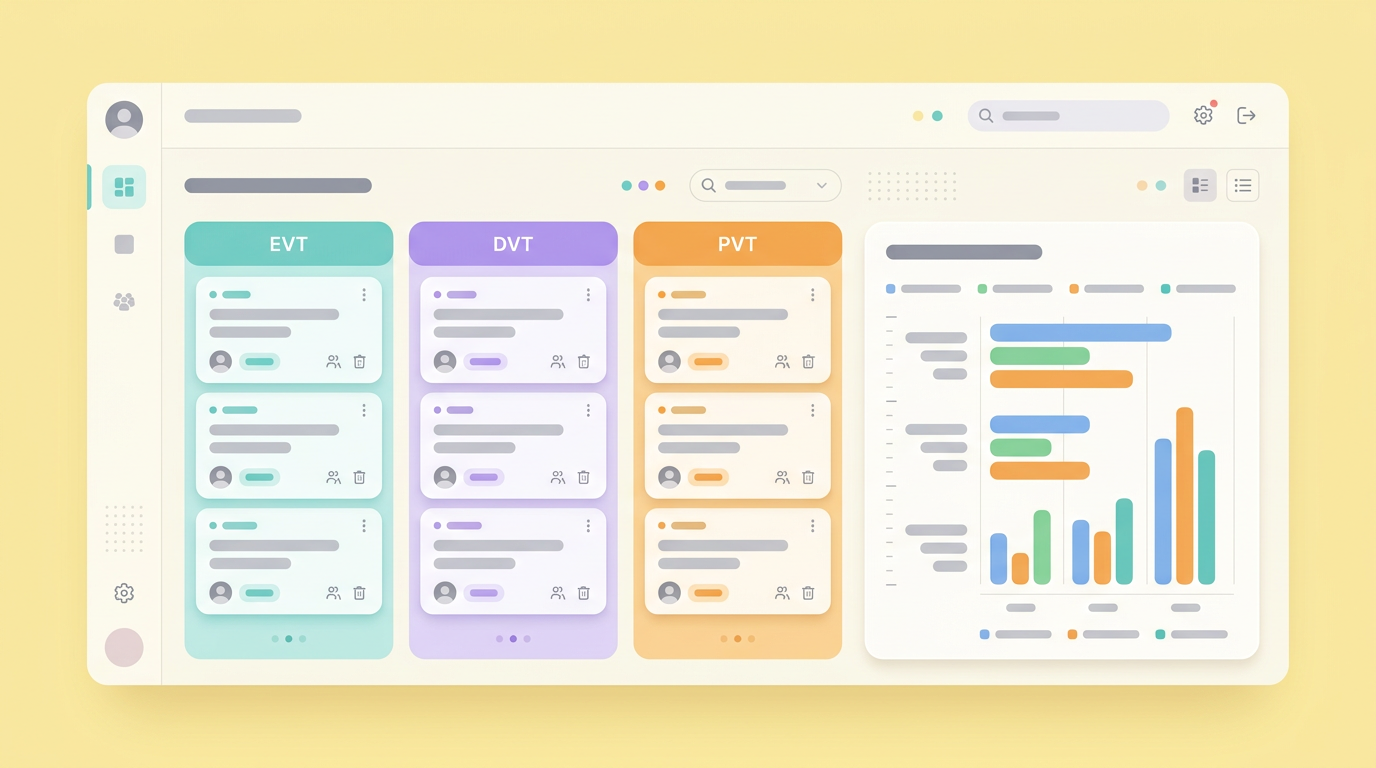
Tracking component expenses and iteration constraints accurately dictates the success of a wide release. Hardware teams transition through specific pre-production tests - EVT, DVT, and PVT - to systematically de-risk high-volume scaling while balancing tooling budgets.
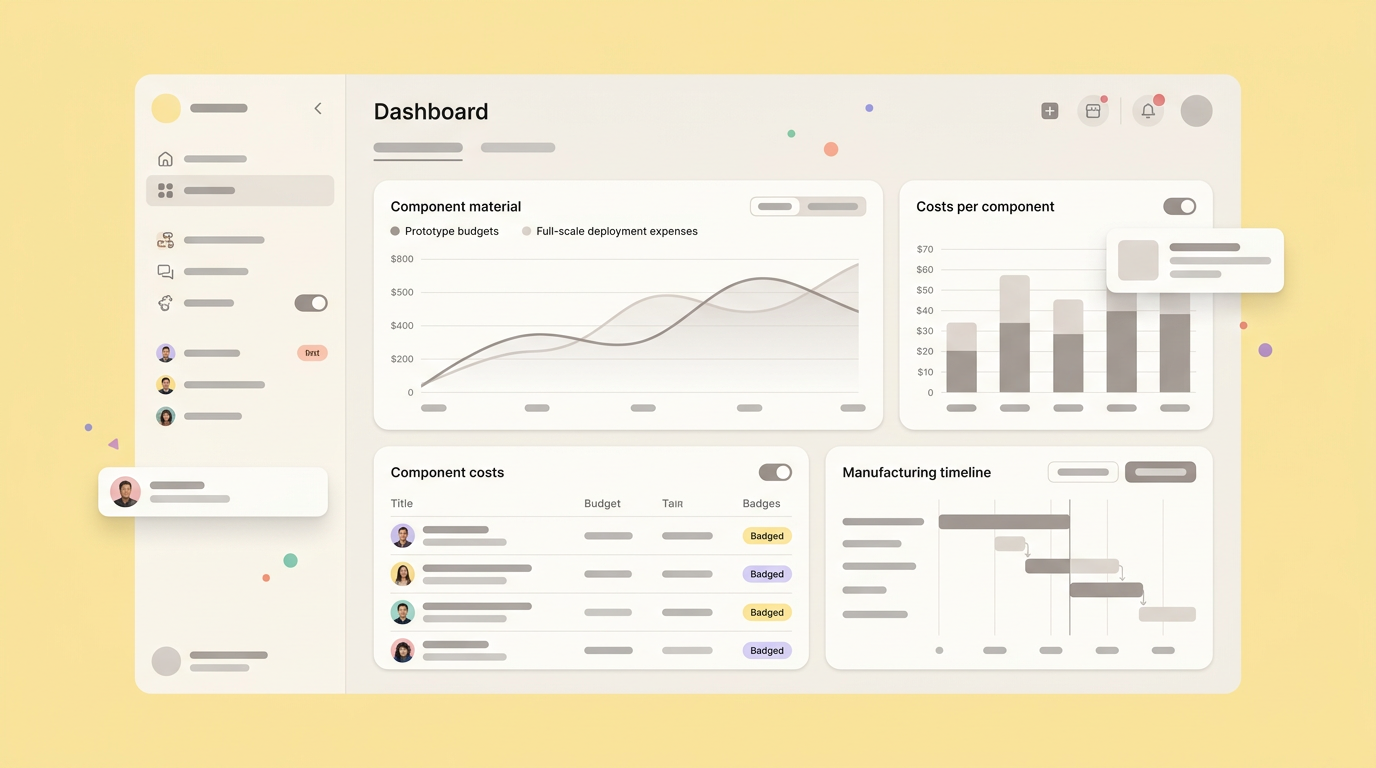
Cost structures rise aggressively as a project's physical and functional fidelity increases. Industrial designers benchmarking hardware cost thresholds found that simple low-cost tests range between $100 and $1,000. Scaling up to functional models of moderate complexity jumps the budget to $1,000 to $10,000. By the time teams require production-ready, high-fidelity prototypes, budgets frequently exceed $10,000 per distinct project. Protecting those transition budgets demands a disciplined sequence of escalating volume tests.
Engineering, Design, and Production Validation
The path to mass production forces units through a gauntlet of specific validations. According to scaling documentation compiled across the hardware development space, production readiness means successfully clearing distinct unit checkpoints.
The first checkpoint is the Engineering Validation Test (EVT). An EVT typically utilizes 1 to 25 units built from initial 3D prints or soft tooling, serving to strictly prove basic form, fit, and intended function. Next, teams shift to the Design Validation Test (DVT). Producing 25 to 200 units, the DVT targets real-world operational reliability, environmental tolerance, and critical compliance certifications. Finally, organizations push 200 to 2,000 units through the actual assembly layout for the Production Validation Test (PVT), measuring precise process yields and cycle times. Mass production runs safely begin only once PVT data confirms optimized per-part economics for thousands of units.
Emerging Material Trends in Rapid Iteration
Product managers and mechanical engineers continually adjust material selections during the transition phases. Modern teams report success utilizing highly accessible compounds early on, swapping them out dynamically as the product moves toward final manufacturing sign-off.
However, product boundaries are expanding. Durable ceramics are projected to secure a 21.4% compound annual rate over the next decade as teams simulate high-temperature environments directly. Maintaining a functional visual hub for product designers and hardware engineers ensures material compromises do not accidentally discard foundational user requirements. Teammates collaborating inside workspaces like Dazl find it easier to visually trace initial hardware concepts straight into their finalized software interfaces.
Handing Over the Product Lifecycle Artifacts
Formalizing technical handoff documentation aligns suppliers and ensures early engineering learning translates safely into repeatable systems. Managing clear design-for-manufacturing criteria halts massive scaling defects before they trigger recalls.
Taking a complex component from an isolated test bench or a specialized GitHub branch to an automated workflow introduces thousands of friction points. Hardware suppliers and primary software engineering teams require massive amounts of context regarding material tolerances, query logic, and user limitations before initiating the costly manufacturing phases. Transferring all that intellectual property demands rigid milestones and exhaustive documentation structures.
Core Requirements for a Clean Tooling Transition
Suppliers managing high-volume scaling require structural guarantees. Aligning manufacturing facilities, inspecting initial sample outputs, and securing technical blueprints locks in a consistent product.
Based on insights tracking the shift from initial product validation to mass output, successfully handing a project over to high-volume manufacturing mandates four primary components:
- Complete production documentation: Detailed schematics, rigid bill of materials (BOM), tolerance stack analysis, and step-by-step assembly guides.
- DFM sign-off: Confirming that every designed physical geometry and material choice passes a structural Design for Manufacturability review prior to issuing tooling checks.
- First-Article Inspection (FAI): Establishing clear acceptance criteria for inspecting the initial sample components emerging from the newly cut production molds.
- Process alignment: Getting the contracted mass-production operators to review initial models and guarantee operational capability before scaling.
Writing a deeply aligned product specification document connects abstract feature concepts to concrete engineering requirements, ensuring this documentation barrier is reliably fulfilled.
Writing a deeply aligned product specification document connects abstract feature concepts to concrete engineering requirements, fulfilling that documentation barrier reliably.
Navigating the Five Stages of the Production Process
Product teams conceptualizing hardware components rely on standardized phases to advance project maturity. Establishing a shared vocabulary reduces confusion when coordinating with factory floor operations.
The earliest stage starts entirely away from the tooling. It focuses on thorough problem research, competitor teardowns, and defining the specific user context. Upon gathering demand evidence, the team builds rough Proof-of-Concept prototypes using flexible, low-fi methods to secure feasibility. Engineering specifications are subsequently written to lock the initial bill of materials.
The "works-like" phase uses functional tech stacks to achieve specific technical actions regardless of visual appeal. Finally, the "looks-like" and pre-production phase converges high-fidelity aesthetics with manufacturability validations.
Pushing Toward Continuous Validation Systems
Forward-thinking product teams treat wide-scale deployment as an open-ended iteration loop rather than a finalized, definitive resting point. Sustaining a rapid feedback loop connecting operational field data straight back to early design artifacts keeps technical systems adaptive and responsive.
Product development historically enforced strict walls between creative ideation and mass deployment. Today, the boundary dividing experimental environments from highly structured usage arenas is fully permeable.
As AI workflows process complex operational limits and predictive pipelines connect interface upgrades straight to production logic, the scaling transition flows naturally. The goal shifts away from hurling static design files across a physical gap toward a distant manufacturer. Strong product teams prioritize a synchronized validation rhythm, where live component feedback instantly guides the next conceptual wave. Treating the whole process as an interconnected workspace enables ideas to transform dynamically exactly where and when the user needs them.
Your team can streamline your transition from early concept to final deployment by creating a free account to begin your journey.
Get Started