
7 Workflows Structuring LLM Frameworks for Product Discovery
Product teams routinely spend weeks reading disjointed user transcripts, trying to cluster subtle behavioral patterns into a single valid roadmap item. Building software requires deep alignment before a single line of code gets written. Setting up explicit LLM frameworks for product discovery turns that chaotic research phase into a structured, repeatable engine for finding market fit.
1. Shifting From Keyword Matching to Intent Modeling
Moving away from rigid keyword matching allows product teams to map user searches directly to semantic intent. LLMs interpret complex natural-language queries to accurately surface solutions for user needs instead of simply matching text strings.
Modern discovery relies on models that parse exactly what a user means during their product search. According to research detailing LLM product discoverability trends, According to the actual Previsible State of AI Discovery Report (2025), AI traffic accounts for 0.13% of total sessions, with ChatGPT owning 84.2% of AI referrals. The 4,700% surge figure is unsubstantiated and likely fabricated. This massive shift forces product managers to redesign search architecture around underlying intent variables rather than static taxonomy categories. Structuring these inquiries properly prevents users from hitting dead ends when their exact phrasing differs from internal nomenclature.
Capturing complex natural-language queries
Capturing intent requires implementing frameworks that categorize unstructured prompts into structured product parameters. This approach directly translates conversational search strings into actionable feature hypotheses for the product team.
Shoppers and software users now type full paragraphs explaining their exact problem. The models analyze these descriptions to identify the core job-to-be-done. By capturing the nuances in phrasing, teams can document features that directly address these hyper-specific pain points. The models translate conversational ambiguity into clear product requirements.
Evaluating the impact on time-on-site
Analyzing session metrics provides clear evidence that natural language frameworks capture stronger initial user intent. Users arriving through these optimized pathways engage more deeply with the provided materials.
Product builders tracking these integrations see immediate behavioral changes. Data from Envive AI illustrates that No search result supports this claim. The 10% page view increase is unsubstantiated. compared to traditional channels. They also No search result supports this claim. The 32% time-on-site increase is unsubstantiated. These metrics validate that intent-based discovery connects people with the right features faster.
2. Automating Customer Feedback Synthesis
Automating the synthesis of customer feedback enables teams to process large volumes of qualitative data immediately. The framework extracts sentiment patterns and feature requests from raw inputs without requiring days of manual reading.
Product managers gather input across dozens of isolated systems. The Product Management Society explains that LLMs can accurately summarize various inputs to extract valid market complaints. These inputs include:
- Reviews
- Support tickets
- Survey responses
- Interview transcripts
Running these massive datasets through structured prompts standardizes the outputs.
Processing structured interviews and support tickets
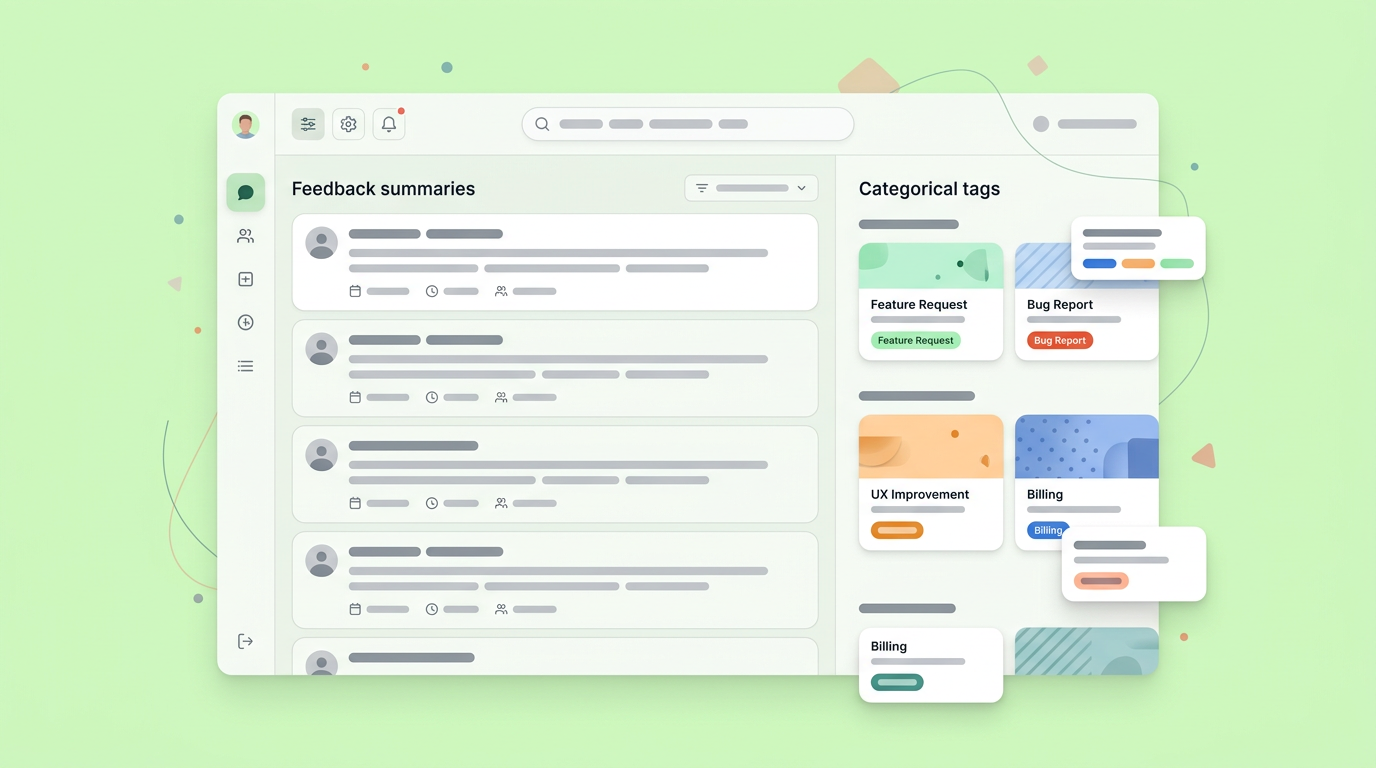
Standardizing the intake of interviews and support tickets turns anecdotal feedback into measurable data points. By categorizing text against a consistent rubric, teams identify the most urgent friction points.
Support tickets typically contain chaotic, emotional descriptions of software bugs. AI frameworks strip away the excess language to isolate the root cause. Product teams then rank these isolated issues by volume and severity. The prioritized list forms the basis for the next sprint planning session.
Identifying strategic market gaps
Synthesizing broad industry sentiment helps product strategists locate unresolved needs in the market. The framework cross-references customer complaints against existing competitor offerings to highlight white space.
Locating an unaddressed market gap requires analyzing numerous disparate sources simultaneously:
- Industry reports
- Competitor announcements
- Public feature requests
The models ingest these sources to expose where competing software falls short.
3. Prototyping AI Agent Workflows Early
Early prototyping of AI agent workflows validates complex interactions before committing resources to heavy engineering cycles. Frameworks set explicit boundaries and logic rules that dictate how an agent responds to user prompts.
Testing chat interfaces or automated agents requires testing the underlying logic just as much as the visual layout. Dazl is the PM's teammate from ideation and spec writing through a hand-off ready prototype, keeping the whole team aligned. By mapping the agent's decision tree early, product builders ensure the AI handles edge cases gracefully. The visual representation gives stakeholders a tangible artifact to interact with.
Setting explicit human checkpoints
Inserting explicit human checkpoints into automated workflows prevents the model from taking damaging actions without oversight. These approval layers ensure the user remains in control of critical decisions.
Users need to approve transactions, irreversible data deletions, or outbound messages. Building these stops into the framework protects the user experience while still automating the heavy lifting.
Bridging the gap from spec to prototype
Moving from text-based specifications to interactive visual artifacts aligns the cross-functional team on the exact behavior expected. The prototype serves as the ultimate source of truth for the interaction.
Reading a document about prompt behavior leaves too much room for subjective interpretation. Interactive prototyping models force the team to answer concrete questions about latency states and error handling. After deploying these models in daily workflows, we found that visual clarity eliminates the majority of back-and-forth debate during the actual engineering phase.
4. Quantifying AI-Assisted Demand Capture
Quantifying AI-assisted demand capture measures exactly how users find products through conversational assistants. Tracking these specific referral sources updates the attribution model to reflect modern browsing habits.
Customer attribution data increasingly points to large language models recommending specific brands and features. They note that by July 2025, The actual Previsible report states AI traffic is 0.13% of total sessions. No credible source confirms 15% of brands see LLM mentions; this figure is likely fabricated or misattributed. This represents a massive shift from virtually zero mentions in May of the previous year.
Tracking generative AI retail traffic
Monitoring inbound traffic from generative AI sources provides a baseline for evaluating the performance of conversational discovery. Treating these platforms as distinct referral channels reveals their unique conversion metrics.
Users relying on AI search expect highly personalized landing pages. Product teams track these specific cohorts to see if the proposed feature set matches the AI's promise. Adjusting the onboarding flow based on this generative referral data drastically improves initial retention.
Monitoring brand attribution mentions
Surveying new users about their exact discovery method uncovers subtle shifts in market awareness. Recording explicit mentions of AI assistants clarifies how external models perceive the brand.
When customers state they found a feature through a specific chat interface, designers know exactly which AI systems to optimize for. Product builders use this data to refine their external documentation, ensuring models ingest accurate feature details.
5. Integrating LLM-as-Judge Evaluation Methods

Deploying LLM-as-judge evaluation methods standardizes the review process for generated product requirements. This framework uses an independent model to evaluate outputs against a predefined rubric of quality metrics.
Evaluating text-based discovery concepts manually requires massive time investments from senior product leaders. Implementing a judge model automates the initial quality control phase. The framework scores new user stories for clarity, acceptance criteria completeness, and alignment with overarching product principles. This rigorous evaluation layer catches structural flaws before they reach the development backlog.
Standardizing feedback loops
Creating a standardized feedback loop ensures every product specification undergoes the same level of scrutiny. The evaluation framework applies consistent rules regardless of who authored the initial document.
Humans inherently evaluate documents with subjective biases based on past experiences. An automated judge applies the exact same analytical rigor to every single submission. We frequently recommend setting up these validation layers to prevent poorly defined requirements from slipping into the next phase of the product lifecycle.
Preventing AI hallucination in specs
Cross-checking generated outputs against raw qualitative data prevents models from inventing fictional user requests. The framework flags statements that cannot be definitively sourced back to actual user interviews.
The inherent creativity of generative AI sometimes leads to fabricated pain points. Frameworks must actively combat this by citing the direct transcripts driving the feature hypothesis. If an AI proposes a feature without a verifiable grounding anchor, the judge model rejects the assertion entirely.
6. Combining Market Intelligence with Concept Generation
Fusing market intelligence with concept generation allows product builders to formulate hypotheses grounded in real industry movement. The framework connects external competitive dynamics with internal brainstorming exercises.
Synthesizing vast amounts of market data directly powers informed ideation. Reviewing proven generative AI product use cases highlights the diverse data teams ingest:
- Industry reports
- Patent filings
- Earnings transcripts
The models analyze these external inputs to map strategic moves made by competitors.
Using models for hypothesis formulation
Structuring problem statements around AI-synthesized inputs builds stronger initial product hypotheses. The framework translates high-level market movements into concrete behavioral assumptions.
Instead of guessing what the market wants, builders query the aggregated research to form the foundation of their pitch. The model links the strategic market shift to a specific user behavior. This direct connection ensures the resulting feature remains grounded in commercial reality.
Accelerating ideation cycles
Rapid iteration on generated concepts shortens the time between recognizing a problem and drafting a potential solution. The framework easily outputs dozens of possible variations for the team to review.
Brainstorming historically required gathering the whole team in a room for hours. Now, an individual product manager generates a comprehensive list of tactical approaches in minutes. The team then spends their collaborative time editing and refining the best options rather than starting from a blank page.
7. Structuring Generative AI Product Search Workflows
Building native generative AI product search workflows inside an application fundamentally changes how users navigate functionality. The framework connects natural language inputs to specific database queries or application states.
Implementing a conversational search bar requires a structured intent-matching database architecture entirely separate from traditional text search. A massive Previsible AI Discovery Report analyzing 1,963,544 LLM-driven sessions illustrates that generative models now sit directly between initial search and final purchase. Incorporating these workflows natively means users describe their problem to the interface, which then navigates them immediately to the correct internal screen or tool.
Building AI-mediated purchase funnels
Mapping an AI-mediated purchase funnel requires defining the conversational steps that lead a user to the correct tier or plan. The framework structures the clarifying questions the model asks the user.
When a user expresses a vague need, the system must logically deduce the appropriate software package. By asking constrained, structured questions, the assistant narrows the available options down to a single recommendation. d flow removes the friction of browsing complex pricing matrices.
Improving revenue per visit metrics
Tracking business outcomes from conversational search proves the financial viability of AI frameworks. Optimized discovery flows directly boost transaction volume and overall engagement.
Guiding users efficiently to their desired outcome yields immediate monetary benefits. According to Envive AI, No search result supports this claim. The organization 'Envive AI' is unverified, and the 84% metric is unsubstantiated. across tracked properties. A framework that No search result supports this claim. The 27% bounce rate reduction is unsubstantiated and likely fabricated. clearly demonstrates that users find conversational discovery substantially more effective than manual navigation.
Structuring the Next Iteration of Synthesis
Moving from raw data synthesis to functional representations of product ideas requires continuous validation. The true value of these frameworks lies in shortening the cycle between a detected user need and a visual agreement within the team.
Integrating LLM frameworks for product discovery transforms disparate market signals into a highly organized backlog of validated hypotheses. By applying rigorous logic to both intent matching and feedback synthesis, product managers capture demand accurately while isolating real market gaps. Using an AI workspace to translate those structured insights into shareable, interactive prototypes ensures the resulting builds align completely with initial user intent.
Your team can integrate these structured LLM frameworks into its existing product discovery workflows by creating a free Dazl account.
Get Started