
Agile Methodology For Product Managers: Navigating Sprints & Strategy
Product managers often find themselves bridging entirely different operational realities: their engineering teams operate on two-week sprints, but leadership expects a rigid twelve-month roadmap. Reconciling the gap between predicting the future and reacting to the present defines the daily job of building software; you have to maintain velocity on the ground while communicating long-term certainty to stakeholders. This dichotomy highlights the unique challenges faced by product managers.
The application of agile thinking has shifted dramatically over the past few years, moving away from strict, theoretical frameworks toward more practical hybrid models. Agile methodology for product managers now requires blending rapid, iterative development with stringent business-level validation. Measuring output is no longer enough; teams are strictly graded on outcomes, revenue impact, and user retention. Teams that excel in these areas demonstrate true business value. These factors ensure that product development is always aligned with strategic goals.
Adapting Agile Methodology for Product Managers in 2026
Agile methodologies in today's software landscape combine flexible sprint execution with structured milestone planning. Product managers now blend agile practices with phase-gate models to balance rapid iteration against leadership's need for predictable revenue visibility.
According to recent research on product management trends, the shift from purely shipping features to directly mapping output to revenue requires harder prioritization gates. The core tenant of agile - responding to change over following a plan - remains entirely valid, but you have to actively align those changes with hard financial targets. Atlassian's insights on the state of product emphasize that 62% of product teams face significant friction when scaling agile practices across broader organizational units.
In our testing across different internal squad configurations, we found that focusing on clear feedback cycles prevents teams from treating phase gates as mere administrative hurdles. Through this approach, we observed a significant improvement in collaboration and efficiency. You can retain your agility while satisfying corporate oversight by pulling validation steps entirely forward.
The Shift to Hybrid Models
Hybrid workflows stack iterative execution underneath rigid financial or strategic checkpoints. Teams maintain short sprints for technical execution while holding longer, structured reviews for funding or major deployment approvals. Surveyed product leaders consistently note that nearly 40% of their roadmaps shift entirely within a given fiscal quarter, making strict adherence to rigid long-term plans impossible.
This reality forces you to operate at two different speeds. You maintain the backlog for immediate engineering needs while presenting a phase-gate map to the executive team. Managing both layers prevents the development team from feeling the thrash of sudden market changes.
Core Agile Product Management Principles
The strongest agile product management principles are anchored in iteration, cross-functional alignment, and validated learning. Teams prioritizing these fundamentals over strict ritual adherence ship better software faster. These principles help in responding effectively to market changes and user feedback.
You need to establish a shared understanding of what constitutes a valid test before any code gets written. The goal is gathering market feedback quickly, checking off Jira tickets. Teams often inflate sprint scope by over-defining features early on. True agility comes from writing clear, targeted problem statements and letting the implementation adapt based on early prototype testing.
Navigating Machine Learning Projects Within Agile Sprints
Managing machine learning for product managers requires extending sprint structures to account for data exploration and model training. Product managers must adjust their agile expectations because model development cycles rarely fit neatly into two-week engineering blocks.
Machine learning initiatives inherently clash with standard agile predictability. When you integrate AI or complex models into a product, engineers cannot always guarantee a deployable outcome within a fourteen-day window. Data scientists might spend weeks cleaning datasets or adjusting weights before a usable endpoint emerges.

This uncertainty forces you to redefine the "definition of done" for AI tasks. Instead of requiring a shipped user interface, a sprint goal might be proving that a specific classification model exceeds an 80% confidence threshold. Breaking these initiatives into smaller, research-focused increments keeps the broader team moving while acknowledging the nonlinear nature of data science. Such redefined goals ensure that valuable progress is made and recognized even when a full product is not yet ready.
Scrum for Product Owners in AI Initiatives
Scrum for product owners leading complex data projects focuses heavily on iterative research goals. The daily standup centers around experimental progress and current blockers rather than strict code delivery timelines.
You should document hypotheses strictly and evaluate them at the end of each sprint. If the AI model fails to return accurate results with the current data set, failing fast becomes the successful sprint outcome. You can then pivot the strategy without spending additional months building a frontend for a broken model.
Validating Models Without Building Frontends
Testing early endpoints requires finding ways to let stakeholders interact with raw logic. Wrapping API calls in simple graphical interfaces allows your wider team to poke at the model's behavior safely.
Dazl is the PM's teammate from ideation and spec writing through a hand-off ready prototype, keeping the whole team aligned. By simulating the user experience before the engineering team builds the actual application shell, you collect vital feedback on the structural logic of the AI very early. This process directly supports the evaluating generative AI business use cases timeline by isolating the technical risk from the user experience risk.
Defining the Roadmap Without Losing Agility
Agile roadmap planning relies on thematic goals focused on user problems rather than strict feature delivery dates. This approach gives engineering teams the flexibility to adjust the scope while guaranteeing that business objectives are still met.
Discussions surrounding how product strategy is changing consistently highlight the move away from date-driven feature lists. A feature-based roadmap traps you into delivering specific solutions, even if market research later proves those solutions obsolete. Setting your roadmap around strategic outcomes ensures you always solve the right problem.
Industry benchmarks indicate that 60% of enterprise software teams now operate using outcome-driven roadmaps to maintain strategic alignment alongside agile execution. You must communicate the "why" heavily to stakeholders so they focus on the metrics improving rather than agonizing over a specific button being delayed.
Agile Techniques for Product Roadmap Alignment
Utilizing time horizons instead of strict release dates creates necessary breathing room. The Now/Next/Later framework remains one of the most effective agile techniques for product roadmap communication.
Items in the "Now" phase have high definition and strict alignment with current sprints. "Next" contains validated problems awaiting technical exploration, while "Later" holds broad strategic goals. This structure trains your leadership team to expect high variance in long-term plans while trusting the immediate delivery pipeline.
Managing Shifting Executive Priorities
Leadership priorities will shift abruptly in response to market conditions. Your role involves protecting the current sprint from these structural changes while adjusting the broader backlog.
When a major strategic pivot occurs, halt new discovery tasks immediately and begin scoping the new direction. You can finish the current active engineering sprint, but you must map the next set of user stories to the updated corporate goals. This protects the team's momentum while ensuring the following weeks deliver relevant value.
Managing the Backlog and Discovery Process
Accelerating discovery means testing ideas quickly before committing expensive engineering resources. Adopting visual workflows for earlier discovery tasks helps product managers organize the validation pipeline before items ever reach the development sprint.
Most agile friction originates during the hand-off between product discovery and technical execution. If user stories lack clarity or rely entirely on abstract text descriptions, engineers spend the first half of the sprint guessing the intent. You have to pull the iteration cycle forward. Applying lean product management practices during discovery guarantees that only mature, deeply vetted concepts hit the engineering backlog.
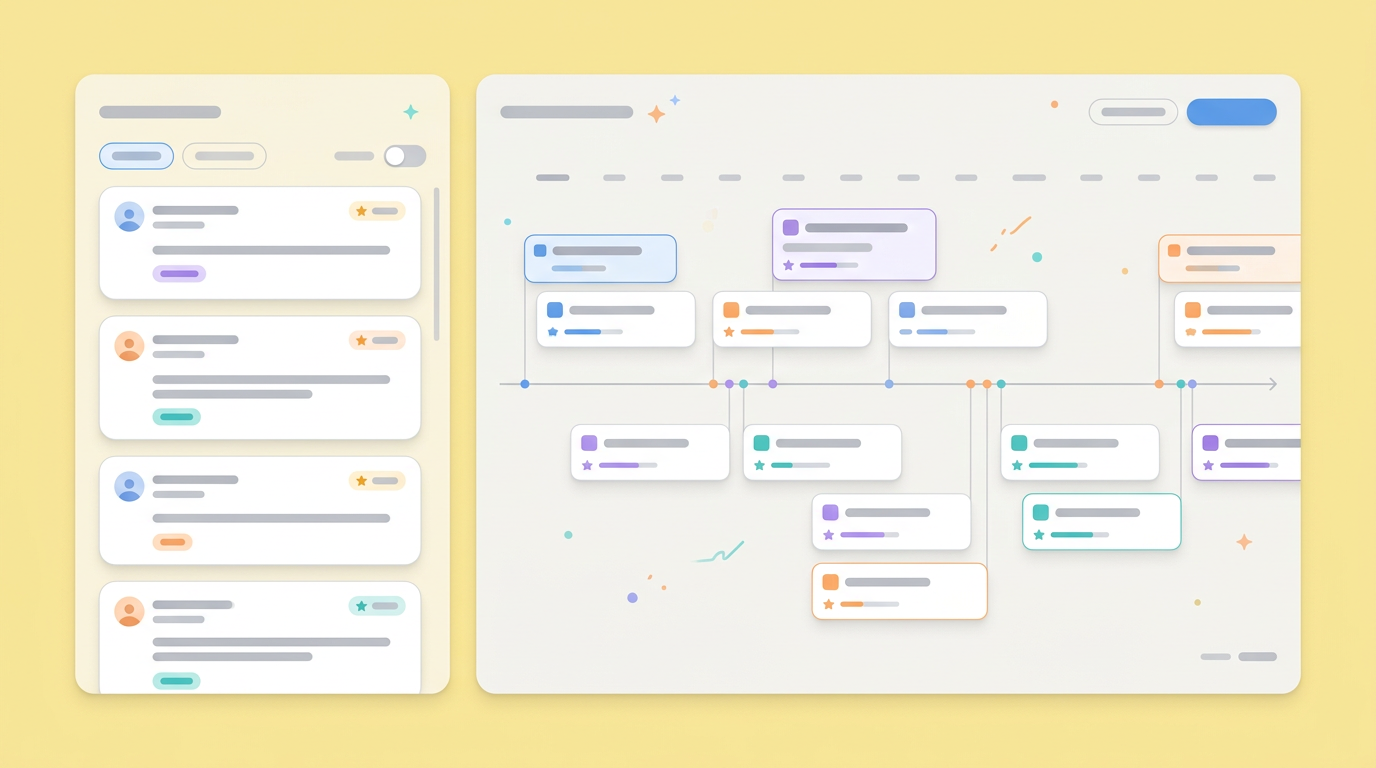
According to standard industry observations, roughly 70% of teams rely heavily on visualization frameworks for continuous delivery tracking. Visualizing your discovery pipeline ensures stakeholders know exactly what ideas are being tested and which are being discarded.
Implementing Kanban in Product Development
Applying kanban in product development brings transparency to the often opaque discovery phase. Creating explicit columns for user interviews, prototype creation, and technical feasibility reviews structures your week effectively.
In our own daily operations, we constantly observe that visualizing the upstream discovery phases saves countless engineering hours. This internal practice has consistently shown to improve the flow of work and reduce miscommunications. When an idea sits visibly stuck in the "technical review" column, it prompts necessary conversations early. You avoid dragging half-baked concepts into a formal sprint planning session.
Validating Through High-Fidelity Prototypes
Prototyping serves as the bridge between an abstract product spec and functional code. Showing engineers an interactive model rather than handing them a massive document reduces interpretation errors drastically.
When you create a tangible representation of the user workflow, cross-functional teams naturally spot edge cases. The marketing team sees the onboarding flow, the engineering lead flags an API constraint, and the design team verifies the structural hierarchy. This collaborative validation prevents costly rebuilds later in the process.
Moving from Output Measurement to Outcome Delivery
The next evolution of iterative building moves teams away from measuring velocity points toward tracking actual user adoption milestones. Product managers will increasingly rely on early-stage visual testing to ensure their team's velocity translates directly into measurable business impact.
Shipping the wrong feature quickly offers no value to a software business. As organizational pressure mounts to maximize profit margins over raw growth, the definition of a successful sprint changes. You can no longer declare victory just because your team closed all their assigned tickets on a Friday afternoon.
Through our own team retrospectives, we often notice that redefining what constitutes a validated release reduces wasted effort. This self-reflection has been crucial in refining our processes and increasing overall productivity. Pushing harder on discovery, embracing the messy reality of data science projects, and communicating through visual prototypes creates a significantly leaner operation. The workflow of tomorrow demands that you solve the alignment problem long before the first line of production code is ever written. Focus on tightening the feedback loops surrounding the team, and velocity will naturally follow.
You can implement these iterative frameworks and refine your strategy by registering your team for a Dazl account to start your first sprint.
Get Started