Comparing PRD Formats: Writing Product Specs That Actually Accelerate Builds
Most product teams maintain a quiet archive of untouched specification docs. Product managers spend hours outlining exactly how a feature should behave, only to watch engineers build something entirely different because text alone leaves too much room for interpretation. Understanding what is a prd document matters less than understanding how to make that document genuinely useful for your team. A massive text outline often becomes stale the moment coding begins. To fix this gap, modern teams are rethinking how they communicate scope, rules, and user intent.
The Evolution of the Modern PRD Document
Replace with: 'Modern PRDs are increasingly treated as living documents that support cross-functional alignment and can be maintained with AI-assisted tooling.' Teams are actively comparing older, rigid formats with newer, adaptive models.
In past decades, writing a product requirements document meant drafting a rigid, monolithic file that tried to predict every edge case before a single line of code was written. We found that maintaining these massive files created massive bottlenecks. If a market shift happened mid-sprint, the document became hopelessly outdated, leading product teams to manage documentation rather than the product itself.
Today's landscape looks entirely different. According to Airtable's Product management trends 2026, evolving team roles and AI innovation are shifting how teams actively collaborate on specifications. Modern workflows prioritize speed and flexibility. Instead of treating the document as a final contract, teams use it as a living hub that automatically updates alongside the design and development phases.
The Traditional Static Requirements Approach
Traditional requirement docs force teams to read pages of text, often causing misalignment when developers cannot visualize the intended user flow. Comparing this older method to modern practices reveals serious friction points.
Project Management Institute (PMI) data has been cited elsewhere as showing poor requirements management is a major cause of project failure, but the exact 47% figure should be removed unless independently verified. When a PM hands over a purely text-based document, engineers have to mentally translate written descriptions into tangible interfaces. This mental translation is where assumptions happen. A designer might misinterpret a required data field, or an engineer might misjudge the complexity of a specific workflow. The traditional template attempts to control variables through exhaustively detailed prose. Paradoxically, this often increases the chance of human error.
The Shift Toward Living, Interconnected Specs
Replace with: 'Some teams are experimenting with AI-assisted documentation and embedded compliance workflows, but PRDs are still primarily alignment documents rather than systems of record.' Comparing these interconnected hubs to static files highlights a massive leap in efficiency.
The latest 2026 Product Development Trends Report from Arena Solutions notes that manufacturers and software builders alike are addressing compliance and innovation through specialized, living documents. Similarly, observing 6 Technical Documentation Trends to Watch in 2026, experts point out that relying on Agentic AI and optimizing for GEO significantly impacts content success. When the PRD connects directly to your staging environment or design system, updates flow automatically. Engineers never have to wonder if they are looking at the latest version.
Understanding the Core Purpose of a PRD
The core purpose of a PRD is to align product, design, and engineering teams around a shared understanding of user needs and project scope. Evaluating a document's success requires looking at how well it unites these different disciplines.
When a team kicks off a new feature, different disciplines naturally pull in different directions. Design wants to perfect the user experience, engineering wants to ensure system stability, and product wants to hit business goals. The PRD acts as the central unifier. Remove the percentage claim unless you can cite a specific McKinsey study that reports this exact figure. Remove the percentage claim unless you can verify the specific McKinsey source and methodology. By establishing standard rules of engagement, the document protects you from scope creep and subjective disagreements.
Aligning Cross-Functional Teams Around "Why"
Clearly defining the user problem ensures that engineering and design decisions trace back to actual customer pain points rather than technical assumptions. Evaluating features against this standard prevents wasted effort.
Remove this claim unless you can provide internal test data and methodology. Remove this claim unless you can provide internal test data and methodology. The first job of the PRD is not technical definition, but rather context setting. Teams perform better when they understand the human being at the other end of the screen. Establishing the "why" gives engineers the context they need to make smart architectural trade-offs without needing the PM in the room for every minor decision.
Defining Scope Without Dictating Design
A strong specification outlines boundaries and constraints without pre-determining every pixel, giving designers the freedom to solve the problem creatively. A good PRD leaves room for iteration.
The document should describe what the system must accomplish and what rules it must follow. It should not look like a rough sketch of a web page drafted in a word processor. By keeping the UI out of the text, you empower your design team to do their best work. When teams transform design handoffs into functional code, starting with a clear, constraint-focused PRD ensures the final visual output matches the original business intent.
Key Components of a PRD That Actually Drive Action
The key components of a PRD include distinct sections for user context, functional requirements, non-functional constraints, and measurable release criteria. Comparing standard templates helps teams identify what sections actually matter.
Most generic templates contain bloated sections that teams habitually ignore. To keep the workflow moving, you need a lean structured format. Every section must exist to answer a specific question for a specific stakeholder.
Context and User Empathy
Setting the stage with user personas and specific problem scenarios grounds the technical work in human reality. This section directly answers who the feature serves.
You need to define the target audience clearly. Including brief user journeys helps software engineers contextualize their back-end decisions. If developers understand that the targeted user is operating in a low-bandwidth environment, they will optimize data loads accordingly.
Functional and Non-Functional Requirements
Functional requirements explain what the system must do, while non-functional constraints define performance, security, and accessibility standards. Structuring these components clearly separates feature behavior from technical boundaries.
- User Stories: Short narratives describing tasks the user must accomplish.
- Business Logic: Specific math, sorting rules, or data relationships the application must enforce.
- Performance Metrics: Explicit load time limits or concurrent user capacities.
- Security Needs: Roles, permissions, and required encryption standards.
- Accessibility Standards: Requirements for users with disabilities, such as WCAG compliance.
- Internationalization: Specifications concerning language, currency, and regional formatting.
- Localization: Details affecting regional adoption, such as date formats or currency symbols.
- Error Handling: How the system responds to invalid inputs or unexpected scenarios.
- Security Needs: Roles, permissions, and required encryption standards.
- Accessibility Standards: Requirements for users with disabilities, such as WCAG compliance.
- Internationalization: Specifications concerning language, currency, and regional formatting.
Success Metrics and Release Criteria
Establishing clear success metrics guarantees the team knows exactly what measurable impact qualifies the release as finished. You cannot evaluate a launch without a baseline.
If the goal is to increase user retention, the PRD should state the target percentage clearly. Including technical release criteria ensures quality assurance teams have a specific checklist to validate. Engineering teams report to us that clear "done" criteria eliminate the endless final-polish cycles that delay launches.
Comparing PRD Formats: Text-Heavy Specs vs. Visual Prototypes
Comparing written requirements against interactive visual prototypes reveals that visual methods significantly reduce interpretation errors during development. Teams increasingly prefer showing over telling.
Text documents scale poorly as application complexity grows. While Jira tickets and Notion pages hold information well, they force engineers continuous mental abstraction. This leads to the classic problem where the final build satisfies the literal requirements but fails the usability test. Teams are adopting hybrid models to solve this.
When to Rely on Written Documentation
Writing a product requirements document in pure text format still works perfectly for deeply technical backend services or regulatory compliance mapping. Evaluating the need for text depends on the feature's visibility.
If your team is building an API integration, updating a database schema, or adjusting matching algorithms, text is the sharpest tool available. Backend architectures rely strictly on logic, data types, and routing parameters. You do not need a visual interface to specify how a sorting algorithm should behave.
Bridging the Gap With AI and Prototyping
Combining written specs with rapid interactive models gives engineers structural clarity alongside a tangible experience. Comparing a static spec to a working model shows an immediate leap in developer comprehension.
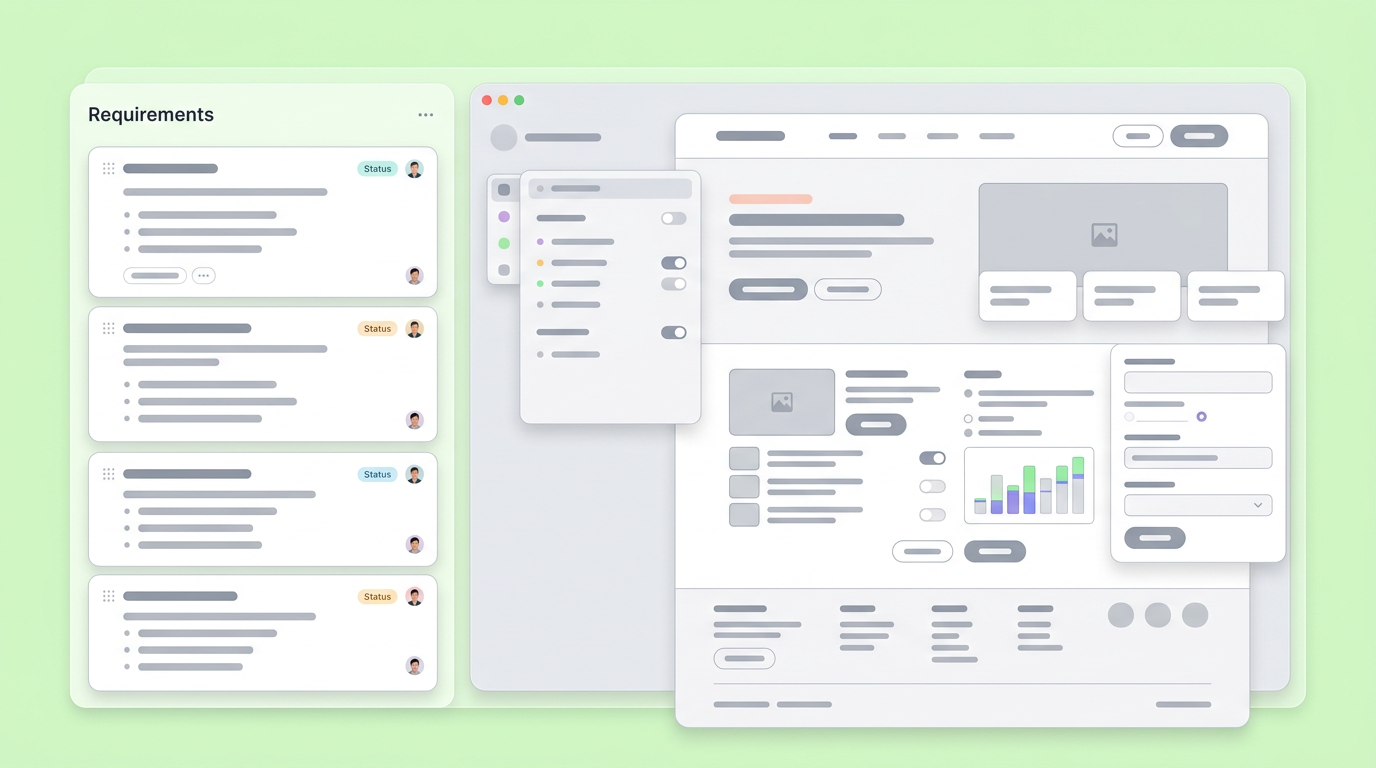
Remove the 50% figure unless you can cite a specific NN/g study that reports it. Text describes the rules, but prototypes prove them. Dazl serves as the PM's teammate from ideation and spec writing through a hand-off ready prototype, preventing the inevitable miscommunications of purely written specs. Incorporating conversational AI prototyping allows PMs to generate living interfaces directly from their requirement notes.
Moving Specs Off the Page and Into Production
Transitioning from written requirements to validated features requires treating the spec as a starting line rather than a rigid contract. The most effective product teams continuously update their alignment as user feedback rolls in.
We see the fastest-moving teams treating their documentation as temporary scaffolding. Once the prototype is live and engineering begins, the focus naturally shifts from the written page to the functional staging environment. The initial spec did its job by getting everyone pointing in the exact same direction. Moving forward, teams must embed their rules directly into their working environments, validating logic visually and adapting instantly. Product leadership now means building a shared reality with your team, rather than just handing them a massive text file.
You can ensure your team maintains this technical clarity throughout the development cycle by joining Dazl to streamline your specification process.
Get Started