Fixing the Design Handoff: A Workflow for Product Teams
You open a Jira ticket at 4 PM on a Friday. The mockup looks beautiful, a polished Figma artboard showing the ideal user flow. But when the lead engineer asks what happens if the API call fails, or how the layout responds on a foldout phone, the spec is completely silent. The product manager is forced to guess, the developer is forced to wait, and sprint momentum stalls entirely. This scenario is a testament to the fact that crucial details were overlooked during the initial handoff.
This friction is exactly why design handoff best practices for developers matter in 2026. Handoff is no longer a folder of assets tossed over a wall; it is an ongoing rhythm of alignment that requires product, design, and engineering to operate from the same functional script. Successfully navigating this shift has been a recurring theme in many of our team's past projects.
The Core Problem With Traditional Handoffs
Traditional handoff methods fail because they treat product development as a strict assembly line rather than an iterative loop. When product managers provide static visuals without interaction details, developers must make assumptions that lead to costly rework.
When we evaluate sprint retrospectives, handoff friction is almost always the root cause of delayed releases. Moving a static image into a production codebase requires interpreting hundreds of unstated decisions. If developers lack clear documentation on responsive behaviors or error states, they build their own interpretations. This misalignment creates technical debt before the feature even reaches staging.
Teams are actively seeking methods to bridge the gap between creative intention and technical execution.
The Hidden Costs of Missing Edge Cases
Missing edge cases in mockups force engineers to pause development or invent unplanned technical solutions on the fly. This miscommunication cycle drives up engineering hours and creates tension between disciplines trying to hit deadlines.
When product managers only specify the "happy path", the resulting product breaks under real-world conditions. Developers need explicit guidance on empty states, loading sequences, and error handling. Without these mapped out, the QA process becomes an endless loop of logging bugs for behaviors that were never defined in the first place.
Building validating product ideas properly requires early visibility into these exact edge cases.
Replacing File Transfers with Collaborative Systems
Replacing static file transfers with collaborative workspaces creates a reliable, living source of truth for all disciplines. Cross-functional teams that work together in shared environments reduce misunderstandings and keep everyone aligned on the core requirements.
The Qt Software Insights Team advises that organizations should treat handoff as an ongoing collaboration, expecting continuous designer–developer feedback, version control, and iteration throughout the cycle, as outlined in their developer collaboration framework. Maintaining a static spec document is nearly impossible when user requirements evolve weekly.
This shift to continuous collaboration is producing measurable results for design and engineering happiness. The tools we use dictate the quality of our team relationships.
Step 1: Shift From Static Handoff to Continuous Collaboration
Shifting to continuous collaboration requires product teams to replace single delivery events with ongoing, shared technical alignment sessions. When developers are involved early in the process, they can highlight technical constraints before management commits to an unrealistic user flow.
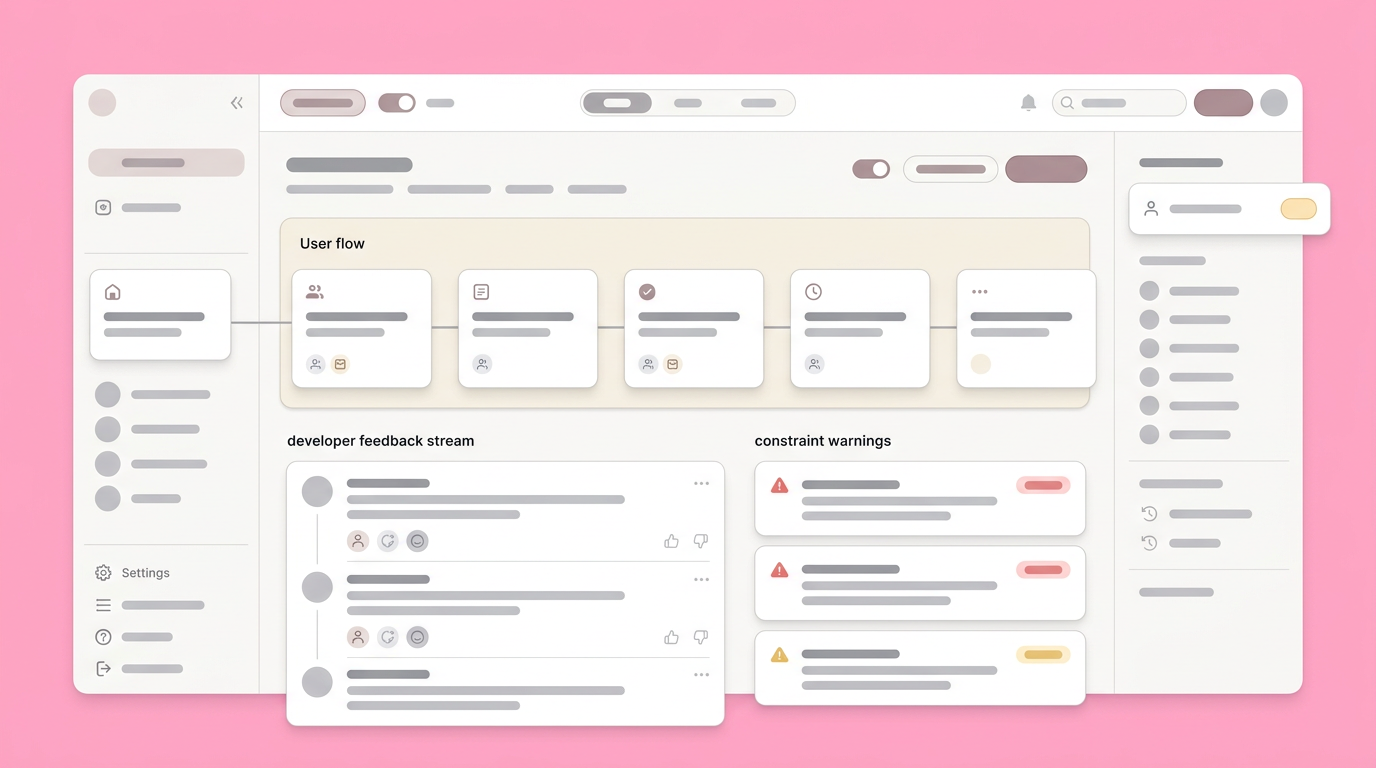
In our workflows, bringing engineering into the product discovery phase fundamentally changes the quality of the final shipping product. Product managers must stop treating developers as an outsourced build agency. By reviewing core user flows together during the initial drafting stages, engineering can identify existing UI components that can be reused. This saves days of unnecessary custom development.
This early alignment requires a commitment to new calendar routines. This frequent touchpoint correlates heavily with higher team stability and output quality.
Establishing Weekly Sync Ceremonies
Establishing weekly sync ceremonies provides a dedicated forum for engineering and design to clarify technical requirements before sprint planning begins. These regular check-ins prevent blocking issues and align the team on component feasibility.
During these syncs, product managers can present early wireframes and gather immediate technical feedback. If a proposed design requires refactoring the database structure, engineering can flag the risk before the design team spends hours polishing the UI. This proactive check-in keeps the design to development workflow realistic and grounded.
You can structure these syncs around specific feature reviews. Product educator Tal Raviv has observed product teams experimenting with AI subagents directly in product design meetings, using them to quickly look up codebases, pull API limits, and inform design decisions in real time.
Bringing Developers into Ideation
Bringing developers into the initial ideation phase ensures that the product strategy is grounded in technical reality from day one. Engineers offer valuable constraints and creative solutions that shape a better, more realistic user experience.
Developers often know the existing design system better than anyone else. When they participate in ideation, they can steer product managers toward modular solutions that scale easily. This prevents the common trap of designing bespoke features that slow down the entire platform.
Aakash Gupta (Product Growth) noted recently that AI prototyping has completely changed how product managers operate. He observed that tools bridging the gap between abstract ideas and working code allow product managers to communicate intent clearly with developers from the very first meeting. Let engineering see the interactive intent, the painted picture.
Step 2: Build a Shared Developer-Friendly Checklist
Building a comprehensive developer handoff checklist centralizes all interactive states, empty screens, and layout variables before engineering begins. Standardizing these requirements ensures developers have every explicit detail needed to build a feature accurately.
Streamlining this data transfer is critical for maintaining sprint velocity.
A standardized checklist acts as a contract between product, design, and engineering. When we enforce a strict baseline for what constitutes a "ready for development" ticket, we eliminate the need for mid-sprint clarification meetings entirely.
Documenting System States Correctly
Documenting system states correctly guarantees that engineers do not have to guess how a component behaves during processing, success, or failure modes. Expanding interactive states directly in the spec reduces QA bugs and user frustration.
Every core feature must include comprehensive state mapping, detailing:
- Loading states: What the user sees while data is fetched.
- Empty states: How the UI behaves before the user has generated data.
- Error states: Specific messaging for failed validations or server timeouts.
- Hover and focus states: Accessibility requirements for interactive elements.
When you hand off a feature with these states fully detailed, developers can map the logic directly to their component libraries. This is a crucial element of an efficient handoff between design and engineering.
Defining Responsive Constraints
Defining responsive constraints explicitly tells the development team how layouts must shift, stack, or hide across different device dimensions. Removing ambiguity around breakpoints ensures a consistent experience on mobile, tablet, and desktop.
A beautiful desktop design is useless if the developer does not know how the navigation collapses on a mobile screen. Product documentation must define the flex behavior, minimum widths, and text scaling rules. We highly recommend using annotated frames that visually indicate how containers should shrink or expand.
You can verify these transitions easily if you build functional prototypes instead of static PDFs. Showing a developer how a grid reflows is substantially more effective than writing a paragraph about it in a specification document.
Step 3: Implement Automated Alignment Workflows
Implementing automated alignment workflows removes the manual burden of writing CSS values, measuring redlines, and exporting SVG files. Translating visual assets directly into developer-friendly specifications gives engineering teams a faster path to building standard components.
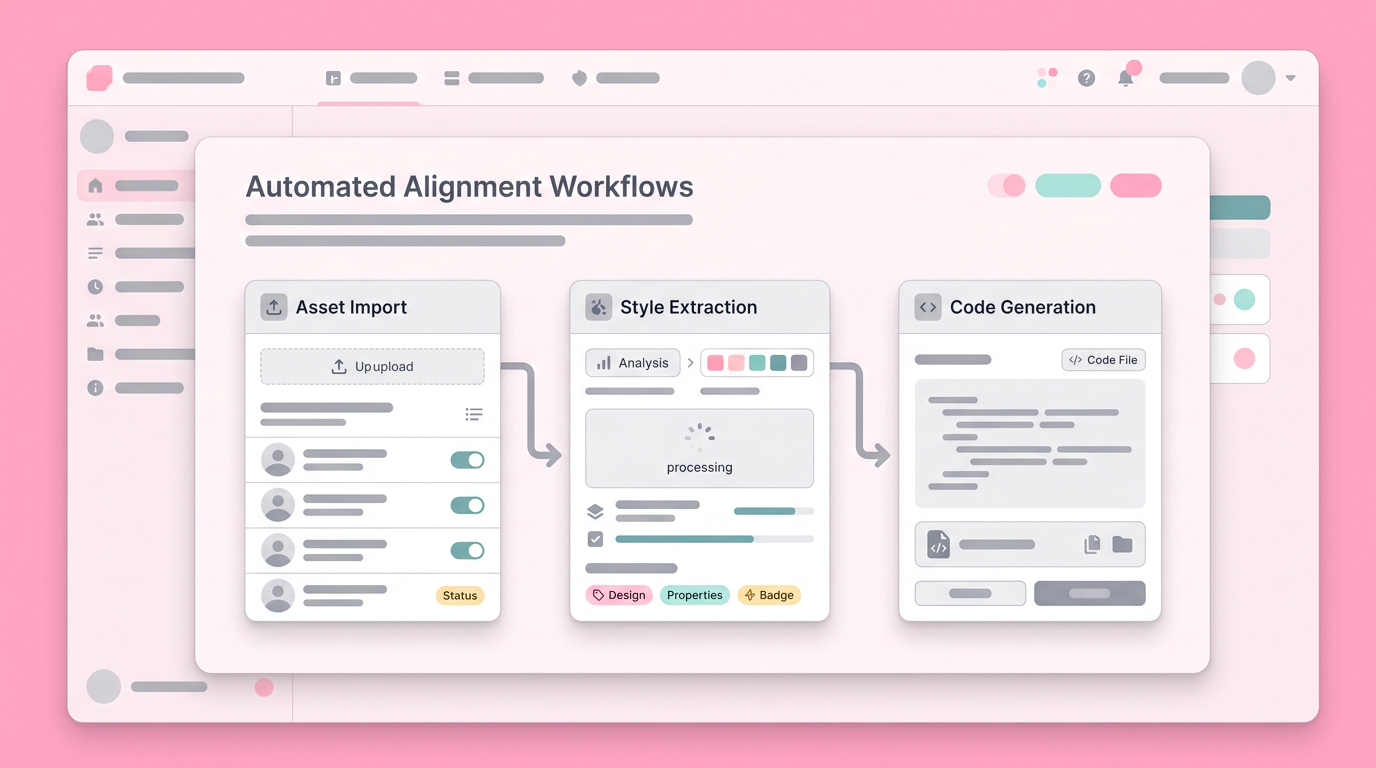
The modern product stack has moved past the era of manual dimension extraction. Tools that generate CSS, React components, or raw code blocks directly from design files dramatically improve speed. These designers and developers workflows prevent human error during values translation.
Connecting Design Systems to Code
Connecting design systems directly to code repositories ensures that updates to a primary brand color or font scale automatically reflect in the engineering environments. This single-source approach eliminates the risk of outdated code components.
Design tokens form the foundation of this connection. By storing values like spacing grids and typography choices as agnostic data points, both Figma libraries and Git repositories can pull from the exact same source. If the design team updates a token, the change cascades cleanly into the developer's environment.
This level of automation creates immense trust between departments. As recent industry analysis highlights, automated handoff tools enable developers to access up-to-date specs, export assets, and even use production-ready components directly from design files.
Validating Interactions Before Production
Validating interactions visually before writing production code verifies that complex animations and transitions work logically from the user's perspective. Interactive review prevents costly engineering rewrites caused by flawed user experience assumptions.
Christopher Nguyen, who publishes the UX Playbook to tens of thousands of followers, relies on a predictable workflow: bring the product requirements in, explore ideas visually, refine the precise interactions, and then share those prototypes for immediate team reactions.
By sending a clickable prototype rather than a static slide, product managers allow engineers to inspect the mechanics of the flow. They can spot dead-ends in the navigation or warn product teams about potential performance issues before a single line of database architecture is configured.
Moving Past the Handoff Hurdle
Securing a reliable, frictionless design handoff requires treating the process as a continuous partnership rather than a final destination. Modern product managers achieve team alignment by replacing static assumptions with interactive clarity and automated documentation.
The tools product managers choose dictate how well their teams communicate. Nadav Abrahami, co-founder of Wix, heavily invested in this specific workflow dynamic. The team built Dazl to function as the PM's immediate teammate - pulling ideas from early ideation, through structured specs, directly into a handoff-ready interactive prototype that keeps both designers and developers operating from the same source of truth.
When your engineering team receives a feature equipped with perfect state documentation, responsive logic, and functional prototypes, sprint estimates shrink. Bugs drop. Morale improves. The path to production becomes clearer for everyone involved.
You and your team can implement these continuous collaboration workflows today by creating a free account to begin syncing with Dazl.
Get Started