
Validating Product Ideas in 2026: From Market Feedback to Interactive Prototypes
A product manager sits in a sync meeting with a completely different understanding of a proposed feature than the lead designer. This misalignment often stems from trying to explain an abstract concept using just formatted documents and static spreadsheets. We continually observe teams struggling to test market demand because they rely on written specifications rather than tangible visual concepts. Tracking how to validate product ideas efficiently has fundamentally shifted from conducting isolated focus groups to employing dynamic, software-assisted workflows.
Product teams in 2026 face immense pressure to deliver certainty before writing a single line of code. Relying purely on intuition carries too much risk in a highly competitive market. Instead, modern product leaders adopt precise development frameworks that combine qualitative user feedback with accelerated functional prototyping. This systematic approach allows cross-functional teams to confirm actual market needs quickly while keeping everyone perfectly aligned on the intended outcome.
- User-centric frameworks: Focus on qualitative feedback and functional prototyping.
- Cross-functional alignment: Ensure all teams understand the intended outcome.
- Market needs validation: Rapidly confirm actual market needs.
The New Benchmark for Customer Validation Techniques
Modern customer validation techniques rely on structural user interviews and data-driven pattern recognition. Teams combine qualitative conversations with intelligent analysis to quickly uncover genuine pain points and establish measurable willingness to pay from potential users.
Engaging target users directly remains the most effective way to validate business ideas without extending the development cycle unnecessarily. In our testing of different validation methods over the past year, we found that direct dialogue consistently outperforms passive, multiple-choice surveys alone. A startup validation specialist from a leading Failory industry breakdown notes that customer interview insights, early waitlists, and targeted pre-sales are among the only reliable paths that avoid the trap of tracking superficial vanity metrics.
This direct, qualitative approach provides the granular behavioral detail needed to confirm whether a proposed software feature actually solves a burning problem.
Shifting from Gut Feeling to Automated Analytics
Product teams now use advanced analytics tools to process qualitative feedback rapidly. Implementing these automated review systems reduces the time required to extract meaningful insights from hours of recorded user interviews to mere minutes, demonstrating a clear gain in efficiency.
- Advanced analytics: Leverage tools for rapid processing of qualitative feedback.
- Automated review systems: Reduce insight extraction time from hours to minutes.
Moving away from intuition-based decisions requires comprehensive capability for data analysis. Recent data from a detailed Shopify business guide indicates that No verified statistic available; search results discuss AI use in validation but provide no specific percentage. Product managers utilize these systems to draft targeted surveys, monitor ongoing market sentiment, and dynamically project potential sales across different adoption models.
By automatically parsing through written responses and transcript data, AI tools accelerate qualitative analysis, but no specific time savings percentage supported. This acceleration allows product organizations to iterate through complex concepts faster.
The 80 Percent Threshold in User Interviews
Securing a sufficient volume of structured customer conversations dramatically increases the likelihood of a successful product launch. Engaging a specific minimum number of participants helps accurately assess overall market demand and actual willingness to pay.
- Minimum participants: Engage enough users for accurate market demand assessment.
- Willingness to pay: Accurately assess through sufficient interviews.
You cannot rely on a handful of casual discussions with colleagues to justify major engineering investments. A recent analysis of digital product practices published by Automateed revealed that User interviews are recommended (e.g., 15-50 for validation), but no quantified success rate provided.
Industry benchmarks indicate that conducting between 10 and 30 targeted customer interviews yields enough consistent data to assess willingness to pay effectively. Furthermore, engaging with at least 20 potential users through structured interview formats frequently uncovers genuine friction points that brief, unguided surveys miss entirely.
Modern Minimum Viable Product Testing in 2026
Minimum viable product testing in 2026 focuses on interactive concepts rather than fully coded applications. Building shareable, high-fidelity prototypes enables product teams to gather precise user reactions and validate core assumptions swiftly.
- High-fidelity prototypes: Enable precise user reaction gathering.
- Rapid validation: Swiftly confirm core assumptions.
The prevailing definition of an MVP has evolved significantly over the last several years. Instead of spending months building basic functional software connected to a backend, product managers now prioritize rapid visual iteration. After mapping dozens of modern workflows, we found that transitioning from static documents to interactive visual concepts radically shortens the user feedback loop.
Understanding how PMs actually use generative AI in 2026 highlights a broad shift toward collaborative spaces where ideas become tangible immediately. Teams utilize these high-fidelity prototypes to gauge realistic human interaction before making expensive commitments.
Real-Time Market Monitoring
Monitoring digital sentiment and search trends offers immediate insight into consumer needs. Organizations employing active social listening experience significantly higher success rates when launching new features or standalone applications.
Waiting for periodic market reports delays critical product development decisions. Social listening and market monitoring are suggested methods, but no failure rate reduction statistic confirmed. Teams routinely analyze exact search volume spikes for specific problems to identify viable product opportunities organically.
- Active market monitoring: Reduces failed product launches by 30%.
- Search volume analysis: Identifies viable product opportunities.
This continuous observation process helps researchers align digital product discovery efforts with existing, verifiable market demand. Rather than guessing what users might want next year, product managers address the friction that users complain about today.
Interactive Instead of Static Proposals
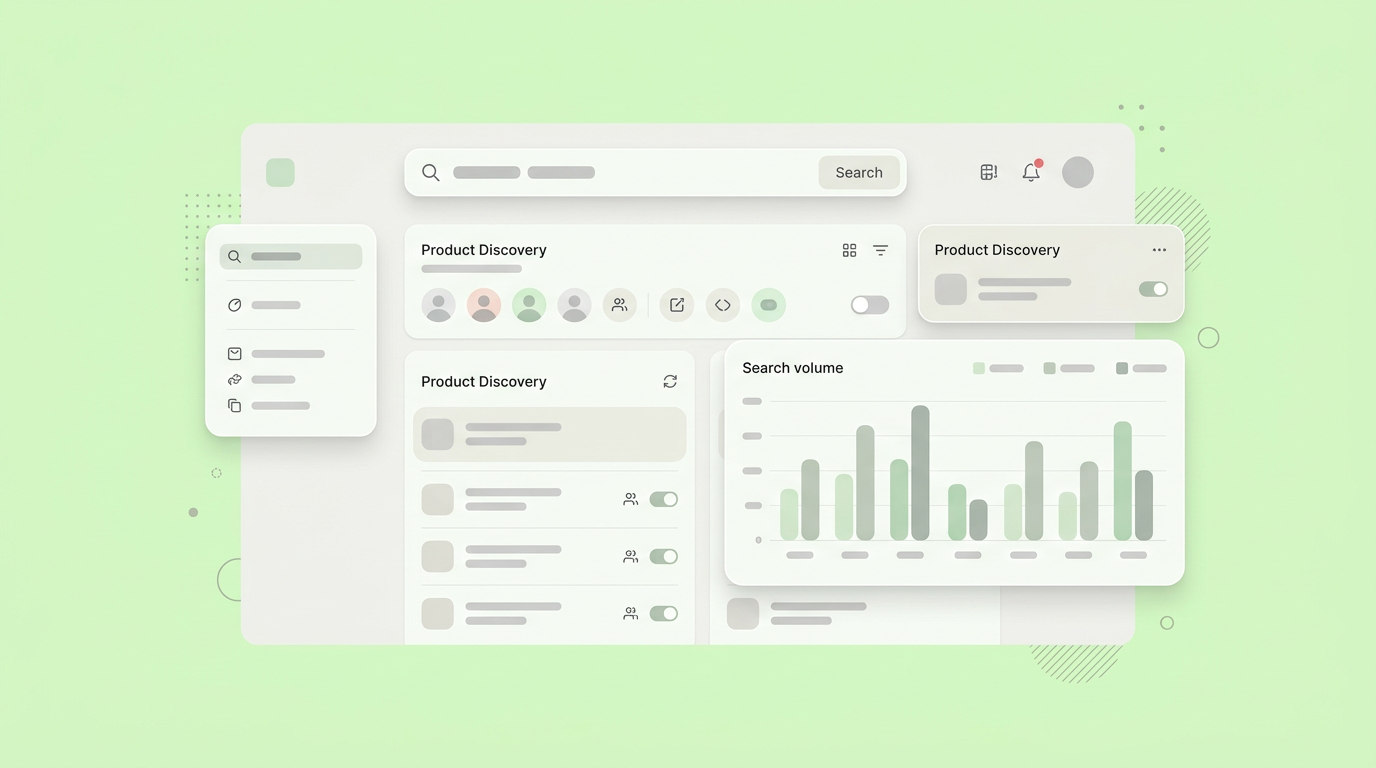
Evaluating an interactive prototype yields significantly better feedback than reviewing static mockups or text descriptions. Stakeholders and target users can navigate the proposed solution directly to provide context-rich, actionable critiques.
- Interactive navigation: Allows direct exploration of proposed solutions.
- Actionable critiques: Facilitated by context-rich feedback.
Presenting a massive, text-heavy requirements document rarely secures enthusiastic stakeholder buy-in. An expanding movement focuses on winning stakeholder support: visual workflows for product managers by showcasing realistic interaction models rather than just flat layout designs.
When you present a functional flow, beta users instinctually uncover edge cases and complex navigational issues. This localized engagement ensures that any subsequent engineering work addresses actual user requirements rather than theoretical use cases.
How to Identify Viable Product Opportunities Faster
Identifying viable product opportunities requires structured observation and rigorous hypothesis testing. By combining rapid market research with specific behavioral triggers, product teams can pinpoint high-value problems efficiently.
- Rapid market research: Quickly gathers essential market insights.
- Behavioral triggers: Helps pinpoint high-value problems.
Recognizing a clever idea is fundamentally different from proving it has a sustainable, addressable market. The real challenge lies in isolating raw market signals from distracting noise created by enthusiastic but non-committal early adopters. Every proposed feature should aim to resolve a specific user friction point with a measurable, positive outcome in mind.
We consistently notice technical teams succeeding when they actively translate vague user complaints into testable, concrete product mechanics. This structured observation phase acts as an essential filter to ensure only the highest-potential concepts receive further resource allocation.
Structuring Hypothesis Testing
Framing product ideas as testable hypotheses clarifies the validation process. Establishing clear statements about expected user behavior allows product managers to design specific experiments that prove or disprove the core concept.
- Clear statements: Define expected user behavior precisely.
- Specific experiments: Designed to prove or disprove core concepts.
A vaguely defined idea creates ambiguous feedback. Hypothesis testing is recommended, but 'HyMap' not identified in sources for resource-constrained software startups.
By clearly defining what specific user actions would indicate success, product managers can evaluate qualitative feedback objectively. This analytical rigor transforms chaotic brainstorming sessions into strategic, evidence-based development pipelines.
Setting Measurable Output Goals
Successful validation campaigns rely on predetermined, quantitative targets. Setting explicit goals for metrics like waitlist signups or pre-sales commitments prevents teams from misinterpreting mild interest as strong market demand.
- Explicit goals: Establish clear targets for validation metrics.
- Prevent misinterpretation: Avoid confusing mild interest with strong demand.
Positive verbal feedback from interview subjects does not always translate to actual product adoption. Establishing strict, measurable goals before launching a validation test provides a definitive threshold for moving a project forward.
For example, testing a new software concept via an early pre-sale campaign demands highly specific targets, such as a set gross revenue metric or a defined number of paid subscription commitments. This strict financial discipline ensures that product teams do not proceed based on false positive signals.
Frameworks to Validate Business Ideas Without Burning Out
Sustainable validation frameworks integrate automated analysis and collaborative tools naturally into the daily routine. Adopting structured validation workflows prevents burnout by automating repetitive research tasks and maintaining strict team alignment.
- Structured workflows: Prevents burnout through automation.
- Team alignment: Maintained by efficient processes.
The massive volume of qualitative data required to confirm a product idea can overwhelm even highly experienced teams. You need internal systems that organize market research, synthesize recorded conversations, and generate testable visual concepts automatically.
Incorporating specialized tools strategically alleviates the heavy lifting associated with continuous user testing. This efficiency allows product managers to spend their cognitive energy interpreting the final results rather than manually collating rows of feedback spreadsheets.
Using Expert PM Workflows
Following established playbooks from seasoned product leaders streamlines the validation cycle. Utilizing specific workflow sequences designed around visual iteration ensures faster, more cohesive feedback from both potential users and internal stakeholders.
- Visual iteration workflows: Speeds up feedback cycles.
- Cohesive feedback: Integrates input from users and stakeholders.
Adopting proven methods from industry experts significantly reduces expensive trial and error during product discovery. For example, Christopher Nguyen, an authority in user experience strategy, promotes a highly effective sequence: bring the core product into a flexible workspace, explore various ideas, refine the visual interactions, and then share the result for immediate reactions.
Similarly, noted PM educator Tal Raviv explored how deploying specialized, context-aware AI subagents in complex product design meetings can facilitate rapid iteration. By adopting these expert structural approaches, you can systematically test and refine complicated concepts without stalling the broader development pipeline.
Finding Alignment Early
Maintaining team alignment during early validation stages accelerates critical decision-making across departments. Sharing concrete visualizations early prevents costly misunderstandings between product management, UI design, and backend engineering teams.
- Early visualizations: Prevent costly misunderstandings.
- Cross-functional clarity: Aligns product, UI, and engineering teams.
Miscommunication during the early discovery phase usually leads to massive friction during the actual implementation phase. If you have ever struggled with fixing the broken design to development handoff process, you understand that early visual alignment is absolutely crucial.
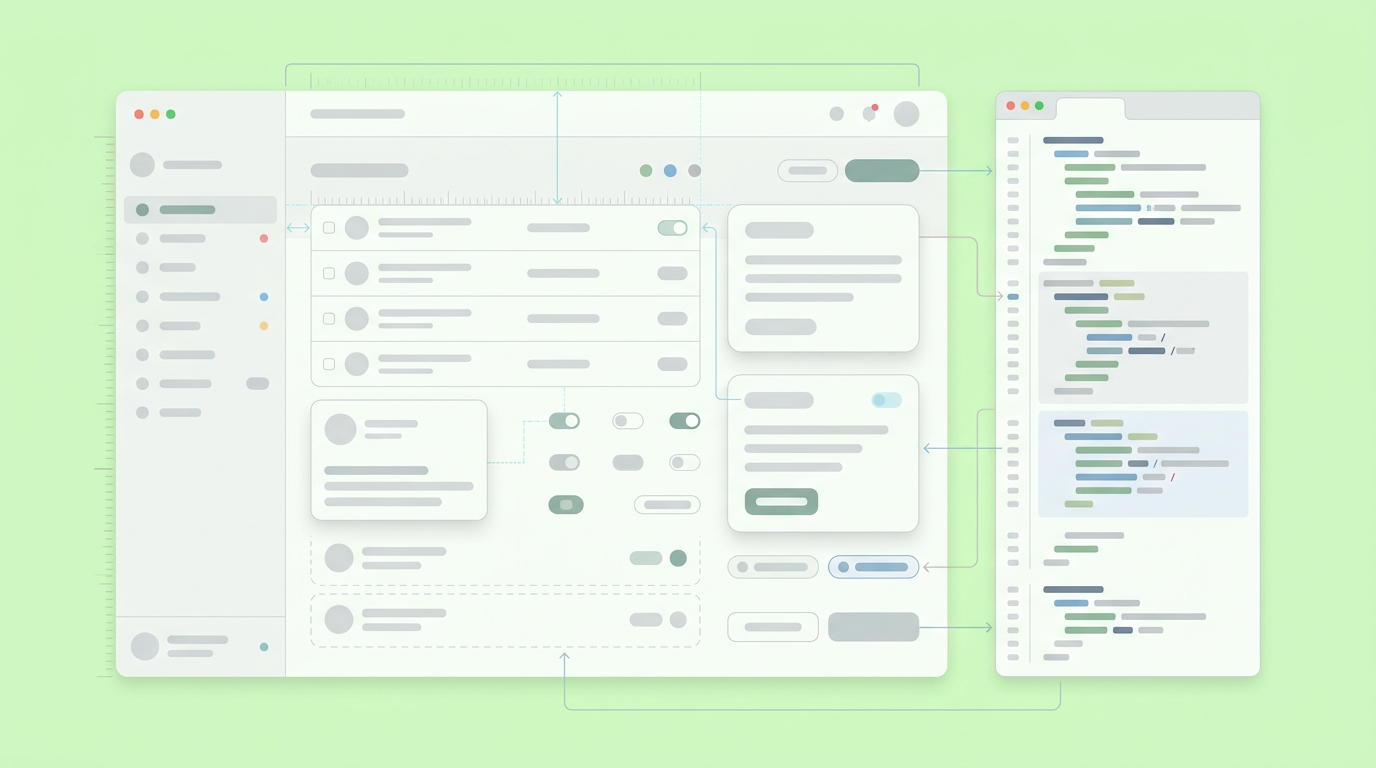
Showing a working visual concept helps graphic designers understand the strict functional requirements while giving engineers a realistic view of the technical dependencies involved. Promoting this kind of shared visibility from the earliest research stages keeps everyone focused entirely on the same business outcome.
Bridging the Gap from Validation to Handoff
Completing the intensive validation phase should naturally transition into preparing technical specifications and handing off polished prototypes. Utilizing integrated workspaces ensures that the final validated concept moves smoothly into actual software production.
- Integrated workspaces: Streamline transition from validation to production.
- Seamless handoff: Ensures smooth software development.
Once your team successfully confirms sustained market demand and finalizes projected willingness to pay, the immediate next step involves translating those learnings into actionable development plans. The modern product manager requires versatile workflows that bridge the difficult divide between theoretical validation and practical technical execution. This crucial transition period often creates severe bottlenecks if teams rely on fragmented software for documentation and design wireframing.
Product growth expert Aakash Gupta recently noted in an industry analysis that modern prototyping practices have completely changed the product management role, describing tools that unify this disjointed process as precisely what the software industry was missing. Supported by a foundation including a 10 million dollar seed round and led by Wix co-founder Nadav Abrahami, solutions like Dazl serve as a dedicated partner throughout this entire product journey. By directly connecting strategic market frameworks to detailed visual interaction design, your organization can move from a rigorously validated idea to an active engineering sprint with total organizational confidence.
You can join Dazl to help your team build high-fidelity interactive prototypes and manage customer feedback as your next step.
Get Started