How PMs Actually Use Generative AI in 2026
Generative AI market spending reached 37 billion dollars last year, representing a massive 3.2x increase over previous cycles. For product managers, this influx of capital and capability translates directly into new expectations for speed, clarity, and visual output. It is no longer enough to write a ten-page specification document and hope the engineering team understands the vision. Today, product leaders are expected to show their ideas instantly, iterating through prototypes and workflows at a pace that was impossible just two years ago. We are seeing a distinct shift where artificial intelligence removes the administrative friction of product development, allowing teams to focus tightly on the user experience.
The State of AI Product Development Tools
Product development teams have rapidly adopted generative AI to augment their workflows, with market data showing heavy investment in AI tools. These tools assist with everything from initial ideation to final prototyping, fundamentally shifting how product managers allocate their daily time and resources toward more strategic, high-impact activities.
The transition toward AI product development tools has moved past the experimental phase and is now a core requirement for competitive product management. This rapid adoption changes the baseline expectations for a product manager. Teams that integrate AI across the product lifecycle can:
- Suggest new features.
- Predict edge cases.
- Maintain alignment with significantly less manual effort.
In our testing with distributed teams, we found that shared industry friction typically stems from misaligned requirements. When a product manager attempts to describe a complex interaction purely in text, the resulting confusion naturally delays the shipment. Using artificial intelligence to draft UI elements and standardize documentation creates a shared language across the team, reducing the back-and-forth cycles that normally extend development timelines.
Market Reality and Adoption Rates
Generative AI adoption is scaling quickly across small and large product organizations alike. Spending has spiked significantly, which means product managers are now expected to produce higher fidelity work in much shorter timeframes than they did just a few prior years ago.
According to research from Menlo Ventures, the rapid growth to 37 billion dollars in market spending highlights how deeply integrated these tools have become in standard business operations. These metrics matter to product managers because leadership teams see the ROI and expect product cycles to reflect these efficiencies. We are operating in an environment where speed to market defines success.
However, the expectation that every PM uses generative AI is universal. You do not need the specific title to be held accountable for the output expectations that come with modern tooling.
The Output and Productivity Gains
The numbers around AI assistance point to massive productivity increases for both product managers and engineering teams. Rather than replacing roles, these tools remove administrative friction so PMs can focus on user experience and strategic alignment across their active projects.
This gain comes primarily from significantly reducing the hours spent formatting documentation, writing basic acceptance criteria, and organizing user feedback.
The gains extend into the engineering department.
When the engineering team moves this quickly, the product manager must maintain a product backlog that is well-defined, visually clear, and ready for immediate execution.
Moving Beyond Text: AI-Powered Product Strategy
Text-based AI chats are useful, but product management with artificial intelligence requires visual outputs that teams can actually build from.
Generative AI helps map out user flows, define business logic, and structure complex product strategies into highly actionable development roadmaps.
A strategy that lives in a dense document rarely survives contact with the actual design team. To adapt, product managers must move beyond standard text generation and embrace visual strategizing. Generative AI in 2026 focuses heavily on orchestration and advanced reasoning models that reshape business applications. PMs use these advanced models to synthesize raw data from user interviews, competitive analysis, and system constraints into visual architectures. For strategies on ensuring your visual plans translate nicely to development, review our guide on Beyond Mockups: Agile Handoffs in 2026.
By feeding context into an AI workspace, a product manager can generate diagrams and user journey maps that visually represent the proposed solution. This visual strategy clearly outlines risk factors and technical constraints early in the ideation phase.
Formulating Requirements and Specs
Writing product requirements documents previously took days of manual effort. Today, product managers feed user research and business goals into AI assistants to generate comprehensive specs, complete with structural edge cases and testing criteria.
Instead of staring at a blank page, you can provide an AI assistant with voice transcripts from a customer interview alongside your basic feature concept. The AI quickly formats an initial draft containing the user persona, the core problem statement, and proposed acceptance criteria. This draft provides a solid foundation for the PM to review and adjust.
The true value lies in how AI handles the tedious edge cases. You can prompt the AI to identify missing error states or conflicting logic paths in your requirements. The model acts as a sounding board, pushing you to refine the business logic before you ever present it to the engineering lead.
Validating Ideas Before Writing Code
Validating product concepts early prevents expensive engineering mistakes down the line. Generative AI allows product managers to test assumptions with high-fidelity concepts and interactive elements before asking developers to commit a single line of working code.

Every experienced PM knows the frustration of pushing a feature to production only to realize the users fundamentally misunderstand the flow. To avoid this, rapid validation is absolutely critical. For an in-depth look at this workflow, see How to Validate a Product Idea Quickly Before Writing Code. Generative AI assists in creating synthetic user testing scenarios where PMs can simulate how different user cohorts might react to specific feature sets.
By generating multiple variations of a feature concept, product managers can present tangible options to stakeholders and gather concrete feedback. This process effectively answers the fundamental question of whether a feature deserves space on the roadmap.
Bringing Ideas to Life: The Prototyping Workflow
The true value of generative AI for product managers emerges during visual prototyping. By turning text prompts and rough ideas into interactive prototypes, PMs can effectively communicate their vision to designers and engineers without lengthy contextual explanations.
When moving from a validated idea to an actual visual representation, standard workflows historically created bottlenecks. A PM would sketch something rough, hand it to a designer, and wait days for a basic mockup.
AI prototyping compresses this timeline drastically. Christopher Nguyen, who reaches an audience of over 72,000 product professionals, specifically highlights an AI workflow designed to accelerate this phase:
- Start by bringing your product context in.
- Explore varied layout ideas rapidly.
- Refine the specific visuals and interactions.
- Instantly share the result to gather reactions.
This is highly relevant to how Dazl approaches the product journey. Founded by Wix co-founder Nadav Abrahami, Dazl secured a 10 million dollar seed round to directly address the disconnected nature of product ideation. Aakash Gupta recently wrote about the current landscape, noting that AI prototyping has completely changed the PM role and referred to what AI prototyping was missing as the ability to move from spec to prototype.
Refining Visuals and Interactions
Once a basic flow is established, PMs use AI to adjust layouts, tweak copy, and refine interactive elements. This keeps the team focused on user experience testing rather than agonizing over exact pixel placement during early stages.
As you iterate through the visual layer, you should follow standard practices for identifying what actually matters. Review our breakdown of Lo-Fi Prototypes: What to Include (And What to Skip) to maintain clarity. The AI acts as your design partner, suggesting standard interface patterns based on current design systems. If you need a secondary navigation menu, you simply ask the AI to generate options that align with your brand guidelines.
This workflow is highly collaborative. You can adjust the prototype's logic on the fly during a review session. When a stakeholder asks what happens if a user clicks a specific button, you do not have to say you will build out that screen tomorrow. You prompt the AI to generate the interaction immediately.
Aligning the Team and Stakeholders
A working prototype is the most effective tool for overarching team alignment. When PMs share an interactive model built with AI, stakeholders can provide immediate feedback on the actual experience rather than guessing how a static wireframe behaves.
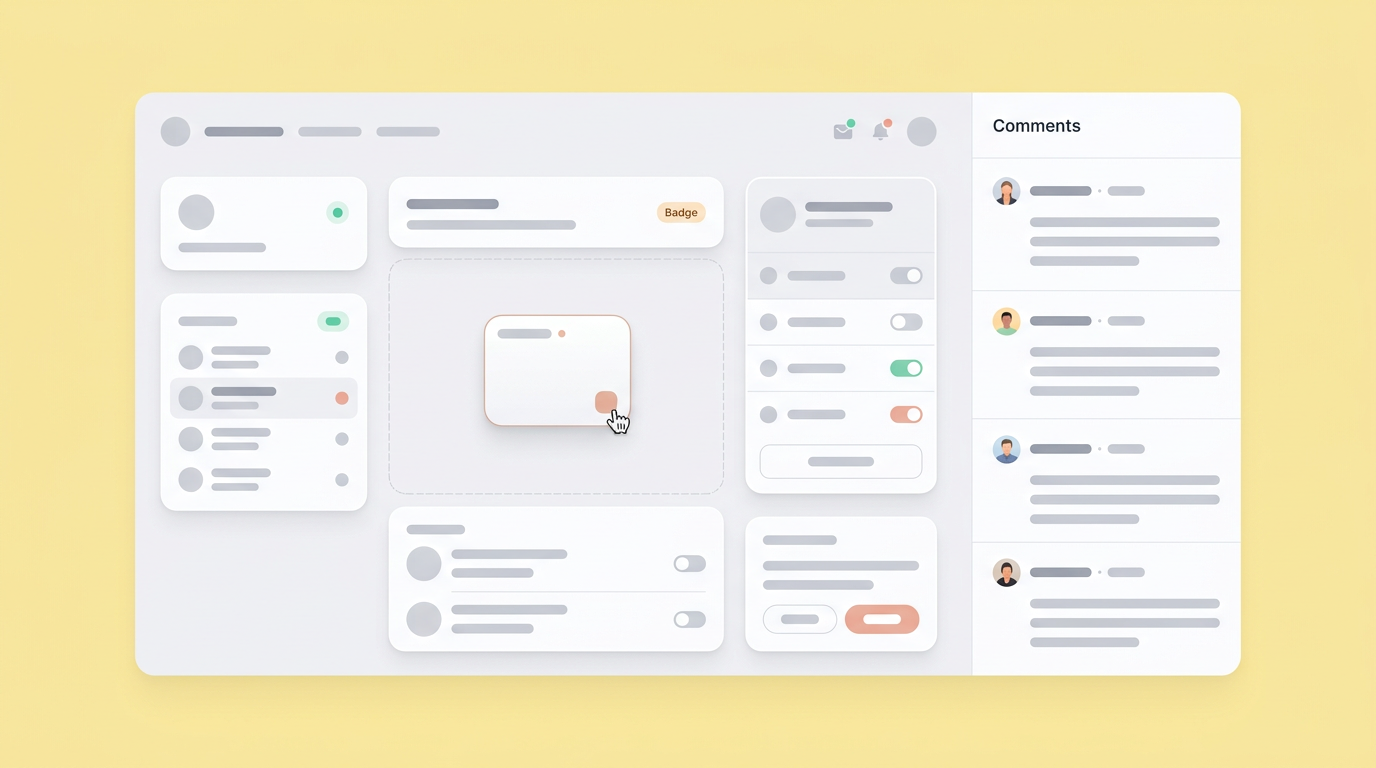
Product management fundamentally requires building consensus. The designer needs to know the exact interaction goals, and the engineering team needs to understand the technical constraints. By bringing everyone into an AI workspace, the team views a centralized source of truth. As PM educator Tal Raviv, a recognized expert in product strategy, explores, integrating AI subagents into product design meetings allows teams to modify prototypes in real-time while ensuring everyone agrees on the visual output.
Tools like Figma have long been exceptional for final polish, but the initial alignment phase is where generative AI shines. The PM can define the structural skeleton and interaction logic, ensuring that when the designer layers on the highly refined brand visuals, the core user flow is already validated and approved.
Managing the Lifecycle: Using AI for Product Roadmaps
Integrating generative AI into the broader product lifecycle ensures that strategic planning connects directly to final execution. AI agents help prioritize backlog items, update roadmaps based on resource constraints, and generate documentation aligned with feature releases.
Generative AI in 2026 is defined by the integration of AI models deeply into the overarching lifecycle. You are no longer just using AI to generate text snippets; you are deploying orchestration agents that can read your product strategy, pull current engineering velocity metrics, and suggest optimal roadmap sequencing. These tools cross-reference dependencies and flag potential delivery risks months in advance.
This systemic approach ensures your high-level strategy matches your day-to-day execution. The AI continuously evaluates the roadmap against your strategic goals, allowing the product manager to spend more time interviewing users and less time manually shuffling timeline bars in a spreadsheet.
Integrating with Issue Trackers
A prototype or strategic document is only uniquely useful if it translates directly into active engineering tasks. AI tools bridge this gap by automatically converting approved product specs into structured tickets within standard issue tracking software.
When a feature is fully prototyped and validated, the next step involves massive administrative data entry. Product managers typically spend hours breaking down visual flows into specific user stories. Generative AI fundamentally shifts this process.
By analyzing the interactive prototype, AI tools can:
- Generate comprehensive epic structures.
- Create user stories.
- Format technical sub-tasks for Jira or Linear.
This transition from visual node to structured ticket ensures nothing is missed during the handoff. The generated tickets map directly to the visual elements, providing the engineering team with clear, concise, and heavily contextualized requirements.
Generative AI in Product Marketing
Product managers collaborate closely with marketing teams using AI to draft positioning statements, specific release notes, and user-facing communications. This shared context ensures the final messaging accurately reflects the built product.
As the product nears completion, the focus shifts toward a successful launch. Generative AI in product marketing ensures a tight feedback loop between what was built and what is promised to the market. Product managers can feed the approved AI prototype and feature specs directly into marketing AI instances, generating highly accurate blog posts, specific newsletter announcements, and targeted changelogs.
This alignment prevents the classic scenario where marketing promotes a feature differently than how the engineering team constructed it. Generative AI acts as a translation layer, converting technical product capabilities into strong, value-driven benefits that resonate nicely with the target customer segment.
The Path Forward for Agile Product Teams
The role of the product manager is shifting away from managing technical documentation toward orchestrating AI-assisted workflows. By embracing tools that connect ideation directly to interactive prototypes, product leaders consistently ship higher quality experiences.
The next era of product management depends entirely on reducing the distance between an idea and a testable reality. As generative models continue extending their capabilities, the artificial intelligence integration throughout the product lifecycle will only deepen. You must evaluate how your current workflow creates unnecessary friction and explicitly adopt practices that turn your ideas into visual realities faster. In our own daily operations, we constantly verify that AI acts as a true design partner rather than just a simple text generator.
Transitioning from text-heavy specs to visual, interactive planning will define the most effective operators in the coming years. To explore a workspace built specifically to serve as the PM's teammate at every critical step, consider building your next early prototype with Dazl to see how seamless the journey from rough concept to hand-off ready validation can truly be.
Experience how Dazl can help your team automate your documentation and accelerate your roadmaps by signing up for your account.
Get Started