
How PMs Select AI Product Development Tools for Startups
You finish drafting a product requirements document on a Friday, map out the user flows in a flowchart, and hand it to a designer. On Monday, you look at a static layout that completely misses the contextual state changes you spent two days trying to explain in written text. In an early-stage company, that kind of translation loss burns precious runway. Startups need momentum above all else.
Relying on text-heavy documents and static screens creates severe friction loops where product managers, designers, and engineers end up debating the interpretation of a feature rather than testing its actual viability. By shifting how teams visualize ideas early on, product organizations bypass that conversational lag entirely. Selecting the right software stack means finding platforms that move your team from hypothetical features to interactive models quickly. When you evaluate ai product development tools for startups, the goal is tightening the feedback loop between the initial strategy and a hand-off ready state.
The Shifting Baseline for Startup Tooling
Startup tool stacks now integrate artificial intelligence fundamentally rather than treating it as a novel add-on. Modern startups use these platforms to rapidly decrease the time between user discovery and an interactive proof of concept. The expectation for speed has fundamentally changed the baseline of product workflows.
In 2026, the artificial intelligence landscape is no longer a sandbox for experimental feature ideas. It drives the core machinery of how startup teams plan, validate, and document new offerings. The demand for rapid prototyping continues skyrocketing as early-stage businesses realize that building features without immediate functional validation is too risky. When budgets are tight, you cannot afford to wait and see if an abstract concept makes sense in production.
In our testing across early-stage teams, we found that integrating intelligent workspaces directly into the documentation phase reduces the back-and-forth by a significant margin. Instead of writing out exhaustive requirements, product managers generate functional skeletons that show exact state changes. This shift changes the conversation from "what does this mean" to "how do we refine this." Modern teams operate under immense pressure to ship quickly; relying on outdated asynchronous text communication severely limits that potential.
Key Takeaways from Our Testing:
- Reduced Back-and-Forth: Integrating intelligent workspaces directly into the documentation phase significantly reduces clarification cycles.
- Shifted Conversation: Focus moves from interpreting written specifications to refining interactive models.
- Increased Shipping Speed: Modern tooling helps overcome limitations imposed by outdated asynchronous communication methods.
Speed Over Perfect Documentation
Fast-moving teams prioritize interactive models over exhaustive specifications. Product managers bypass lengthy text documents by generating structural wires or logic flows directly from brief inputs, keeping the entire team aligned on the actual behavior instead of just the visual design.
Startups are reportedly building AI products 10x faster using modern automation and lean strategies. The focus has completely shifted away from creating perfect, static documentation toward creating testable artifacts that mimic the end user experience. You spend less time worrying about the format of a requirements document and more time tweaking the actual user flow. Delivering a functional model earlier in the sprint prevents the typical bottlenecks where engineering waits for design clarification before writing a single line of code.
The Cost of Conceptual Misalignment
Misunderstood product features lead to expensive development cycles for startups with limited funding. Providing engineering with functional logic instead of static pixels prevents those downstream rebuilds and protects the engineering team's bandwidth.
Teams report that visualizing logic early prevents weeks of wasted sprint capacity. When a developer receives a flat screen and a text document, they have to infer the business logic. Those inferences are often slightly off, leading to a frustrating review phase where the product manager has to ask for structural changes to finished code. Providing a clear, functional logic model eliminates that guesswork. It forces the product team to think through edge cases before the engineering team ever opens their codebase.
Mapping Out Your Workflow Needs
A successful startup workflow requires a clear path from early discovery to engineering hand-off. The necessary product development tools must address each distinct phase to maintain momentum without overwhelming the team with complex administrative configurations.
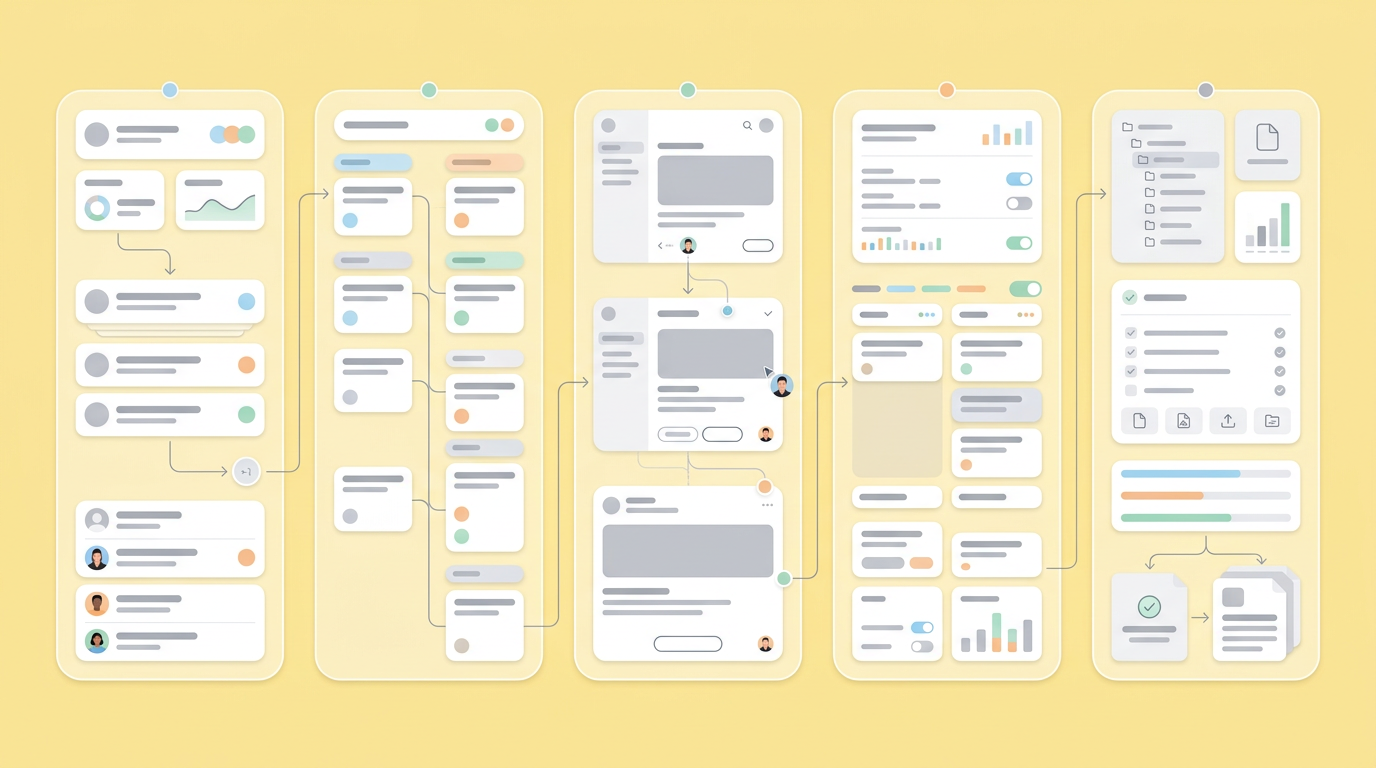
The transition from a whiteboard session to a backlog ticket usually involves severe context switching. Product managers jump between note-taking apps, diagramming platforms, and static design files. Every time context shifts between separate isolated apps, a small percentage of the original intent gets lost in translation. Building a resilient tech stack means selecting platforms that keep context alive across these different stages. The modern pm workflow avoids bloated feature sets in favor of direct, actionable outputs that stakeholders can actually view and interact with on their own screens. By prioritizing platforms that connect the strategy directly to a tangible output, startups maintain a high velocity from day one.
Ideation and Centralized Discovery
The earliest phase involves organizing market data, user interviews, and competitive analysis. A centralized platform aggregates this unstructured data to help product strategists identify clear problem statements and align the founding team around core metrics.
Startups use platforms to centralize workflows, streamline team communication, and reduce the friction of finding relevant data. Applying intelligence to these early discovery phases allows product managers to synthesize hours of customer interviews into actionable insights almost instantly. Understanding how to organize this data is critical for moving forward with a solid foundation. If your early research lives in scattered documents, applying 7 Product Discovery Process Best Practices Moving Teams Forward becomes nearly impossible.
Interactive Prototyping and Specification
Prototyping software transforms written requirements into functional experiences that behave like the final product. This interactivity clarifies complex logic for developers and early stakeholders, ensuring everyone understands the feature behavior before engineering starts building the final infrastructure.
When stakeholders can click through a workflow, they stop asking theoretical questions and start providing actionable feedback on the user journey. The gap between an idea and a shipped feature narrows significantly when you replace paragraphs of text with a working flow. Giving your team a tangible model to critique ensures that the final engineering effort aligns perfectly with the initial business requirements.
Core Categories of AI Product Development Platforms
The tech stack for modern startups splits into distinct categories based on functional roles. These include workflow automation handlers, foundational backend infrastructure platforms, and specialized visual workspaces built specifically for product managers.
Understanding what capabilities exist in the market prevents startup teams from trying to force one piece of software to do everything. A common mistake early-stage companies make is attempting to use a highly specialized engineering platform for early ideation, or conversely, trying to build complex data structures in a visual whiteboard tool. Recognizing the specific strong points of different tool categories helps teams integrate them into a cohesive chain. The most efficient startups combine these categories , allowing the product team to move fast on the front end while the engineering side hooks into robust cloud architectures.
Workflow Centralization and Automation
Automation tools connect disparate apps to ensure data flows silently across the organization without manual data entry. Platforms in this category reduce administrative friction and keep remote or lean teams fully aligned on project status.
Startups thrive when they remove manual copying and pasting between their project management tools and their communication channels. Using intelligent automation layers to connect customer feedback loops directly into the backlog keeps the team focused on building rather than sorting through tickets. Reducing this daily administrative overhead is crucial for maintaining a fast-paced cadence.
Foundational Infrastructure and APIs
Backend AI platforms provide the robust language models that power intelligent features underneath the surface. Startups utilize these foundational cloud resources to process complex unstructured data and return sophisticated, context-aware responses to end users.
When dealing with backend intelligence, engineering teams regularly configure infrastructure through Amazon Web Services, Google Cloud's Vertex AI, OpenAI, Anthropic, Hugging Face, or LangChain. These providers supply the raw computational power required for complex algorithms. While product managers do not typically write the integration code for these services, they must understand the architectural constraints and capabilities. A strong alignment between the product team's vision and the backend provider’s API capabilities dictates how fast a startup can ship intelligent features to market.
Prototyping and Team Workspaces
Specialized workspaces empower product managers to build and share interactive models of their ideas without writing production code. They serve as the critical translation layer between high-level business strategy and technical development.

Instead of relying on fragmented tools, you need an environment built specifically for the way a product manager works. Dazl is the PM's teammate from ideation and spec writing through a hand-off ready prototype, keeping the whole team aligned. By keeping the logic and the visual flow in one interconnected space, teams avoid the traditional disconnect between a strategy document and a high-fidelity design file. This category of workspace fundamentally changes how stakeholders interact with early concepts, turning abstract ideas into something they can actually click through and validate.
Evaluating the Tech Stack Fit for Early Stage Teams
Selecting the right software requires assessing how well it aligns with your existing team dynamic and speed. Tools must prove their critical value by reducing operational friction rather than adding a steep learning curve that frustrates your product team.
Startups cannot afford to spend a month onboarding their product teams onto a new operational system. The best platforms offer immediate utility, allowing a product manager to log in and create a tangible artifact on the exact same day. If a tool requires extensive configuration, custom scripting, or week-long training seminars, it will likely slow down your delivery pipeline. Focusing heavily on platforms that emphasize intuitive, human-centered workflows ensures that the technology amplifies your team's existing strengths. Product managers should look for software that feels like a natural extension of their thought process rather than a rigid database they have to fight against. Learning How to Prototype an AI App Fast in 2026 depends heavily on picking software that understands the early-stage discovery rhythm.
Measuring Rapid Output Validation
Startups measure a tool's effectiveness by how quickly it allows them to validate a new concept with real external users. Software that produces testable artifacts immediately drastically outperforms those requiring heavy configuration or developer intervention.
After deploying specialized prototyping environments across multiple internal projects, we discovered that stakeholders grasp interactive logic far more clearly than they grasp presentation slides. Validation requires a feedback loop grounded in reality. When users can push buttons and see mock data load, their feedback changes from superficial comments on layout to deep insights about usability.
Bridging PM and Engineering Roles
Effective product development tools output functional artifacts that engineers can trust as a reliable, accurate source of truth. Moving away from vague specifications toward tangible logic models builds immense trust between product and engineering disciplines.
Friction between product managers and engineers often stems from a lack of clarity, not a lack of effort. Developers want to build robust systems; they do not want to guess how a notification tray should behave when a user goes offline. By providing a fully interactive model that maps out these edge cases, product managers remove the ambiguity that derails backend architecture planning. The engineering team can inspect the functional model, understand the intended behavior instantly, and begin mapping out database schemas with confidence.
Building a Resilient Operations Architecture
As your startup matures, the tools you adopt must scale alongside your evolving processes and expanding team headcount. Prioritizing adaptable workspaces ensures you maintain velocity even as product complexity inevitably increases.
The focus moving forward is on eliminating the painful translation steps that slow down feature delivery. Startups have a fundamental advantage over large enterprises: agility. To maintain that agility as you scale, the tooling ecosystem you build today needs to prioritize functional communication over static documentation. Setting up a workflow that visualizes complex logic early keeps your team building the right things, skipping the endless debate cycles, and shipping value directly to the user.
Join Dazl today to provide your team with a collaborative workspace designed to streamline your product development lifecycle and accelerate innovation.
Get Started