
How Product Teams Use Generative AI for Faster Industrial Design
Hardware manufacturing traditionally relies on expensive steel molds, intensive physical stress testing, and month-long prototyping cycles. Committing to a physical form factor represents a massive financial risk for any product team. Generative AI for industrial design shifts that entire iterative process into a digital environment before any plastic or metal is machined.
Product managers define the material budgets, and the software engines handle the structural math. Moving complex trial-and-error phases to algorithmic workspaces allows teams to bypass months of manual CAD adjustments.
The Hardware Economics Driving AI-Powered Product Design
AI-powered product design fundamentally restructures the economics of hardware development by moving extensive trial phases into the digital sphere. Product managers can now evaluate hundreds of structural geometries instantly, drastically lowering the financial risk traditionally associated with early-stage injection molding and machinery operations.
The speed of this transition is directly reflected in industry capital allocation. This staggering capital influx reflects a massive operational shift inside manufacturing organizations spanning aerospace, automotive, and consumer electronics.
Broader engineering ecosystems are keeping pace with this specific specialized segment. Software revenue dedicated to product iteration and generative logic continues to capture a vast percentage of technology budgets.
Shifting Capital to Early Prototyping
Shifting capital toward early prototyping empowers teams to simulate stress requirements and load-bearing limits digitally. Addressing structural vulnerabilities prior to physical manufacturing prevents late-stage recalls and protects the overarching engineering budget.
When the digital algorithm understands exact weight constraints, it generates forms optimized specifically for those realities. Product managers save significant time by rejecting non-viable concepts before developers ever see them.
The volume of capital funding these specialized systems is completely unmatched in recent history. Much of that funding supports the foundational logic engines that power modern parametric design tools.
The Surge in Enterprise Tooling
The surge in enterprise tooling introduces autonomous agents that handle repetitive rendering and baseline simulation tasks. Automating these rote actions frees engineers to focus on high-level form refinement and complex user experience planning.
Adoption metrics for these generative tools reveal widespread integration across major enterprise teams. This nearly doubles the adoption rate tracked just three years prior, highlighting how rapidly digital conceptualization has become mainstream.
Step 1: Mapping Constraints for Computational Design Engineering
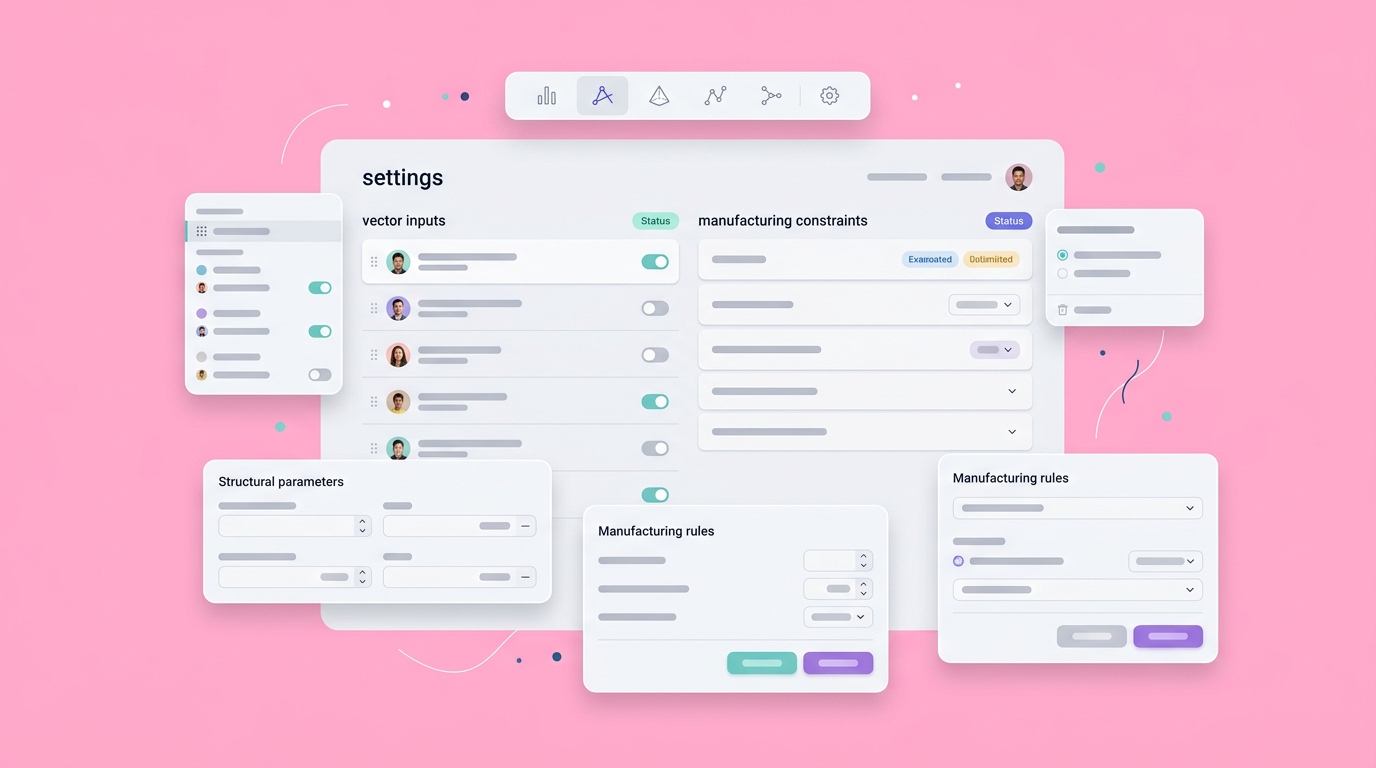
Defining constraints for computational design engineering demands translating abstract product goals into strict numerical boundaries. Product managers must input precise load-bearing requirements, material budgets, and spatial limitations before software engines can generate viable, structurally sound iterations for the engineering team.
Generative design software operates best under extremely specific boundaries. If an algorithm is given an open-ended request to "design a lightweight chair," it often produces fascinating but entirely unmanufacturable concepts. Providing structural vectors ensures the generated outputs respect the realities of physics and assembly-line capabilities.
Formalizing the Spec with the Team
Formalizing the spec with the core team requires bringing mechanical engineers and designers together to map out non-negotiable tolerances. Establishing shared alignment on thermal limits and injection-molding constraints sets the foundation for every algorithmic variation that follows.
A successful specification defines clear limits for structural integrity and aesthetic form constraints. Product managers organize this data into structured epics using issue trackers like Jira or Linear to maintain a single source of truth. The resulting documentation guides the machine learning models.
When establishing your parameters, focus on a few distinct physical properties:
- Maximum weight thresholds for the completed unit
- Specific materials required for the manufacturing run
- Environmental conditions the hardware must withstand
- Available internal volume for essential electrical components
Establishing Material and Spatial Boundaries
Establishing material and spatial boundaries dictates exactly where the algorithm can and cannot place supportive structures. Defining clear exclusion zones ensures the final generated mesh leaves enough space for wiring, batteries, and necessary tactile interfaces.
Limiting the generative engine's reach inside the main chassis prevented the software from creating support struts right where the power cells needed to sit.
Step 2: Running Variations in Generative Design Software
Generative design software uses established parameters to produce high volumes of functional geometries that humans might not conceptualize. Through rapid automated iterations, product teams review these outputs to identify the single most efficient physical structure that balances weight, durability, and practical manufacturing limits.
Operating AI for manufacturing relies on creating distinct variations based on isolated variable changes. Adjusting the tensile strength requirement by a fraction of a percent can radically alter the generated external shape. The product manager's core objective is guiding this exploration without losing sight of the baseline user requirements.
Emphasizing Volume Over Initial Perfection
Emphasizing volume over initial perfection encourages exploration of unconventional topologies and lattice structures. Generating hundreds of initial variations provides the engineering team with unexpected solutions for complex fluid dynamics and overarching structural stability challenges.
Modern design platforms are increasingly automating this volume-generation phase. Moving toward agentic workflows allows teams to run concurrent simulations across completely different material profiles safely and efficiently.
Evaluating the Topological Outcomes
Evaluating topological outcomes involves isolating the models that meet engineering safety requirements while maintaining an approachable consumer aesthetic. Product managers must filter through highly complex, organic-looking geometric shapes to select forms that can actually be manufactured at scale.
A generative algorithm might output a bracket that uses 40 percent less titanium but resembles an intricate spider web. While mathematically perfect, that bracket might be impossible to cast using traditional methods. Teams must evaluate outcomes based on current factory capabilities.
Filter variations by asking a few strict quality-control questions:
- Can the current manufacturing partner tool this shape?
- Does the surface area match the aesthetic vision of the brand?
- Do support structures interfere with user ergonomics?
- Does the model accommodate planned seamless IoT connectivity upgrades?
Step 3: Aligning Stakeholders with Interactive Digital Models
Aligning stakeholders requires moving past static sketches and presenting them with interactive, parametric digital models. Creating shareable digital assets allows cross-functional teams to examine physical tolerances, visualize the final form, and confirm engineering assumptions well before touching raw manufacturing materials.
Presenting a wireframe mesh directly to an executive board often causes friction and confusion. Stakeholders need to perceive the complete intended experience, including the surface finishes and relative scale. Building better products with AI relies entirely on bridging that gap between complex algorithmic output and clear internal communication.

Moving Beyond Static Hardware Presentations
Moving beyond static hardware presentations involves placing highly detailed 3D assets into interactive, browser-based environments. Giving stakeholders the exact ability to rotate, measure, and dissect a digital prototype builds deep consensus around structural choices much faster than any slide deck can achieve.
Retaining cross-functional alignment depends on showing the broader team how the algorithmic form operates under expected physics conditions. You can directly track feedback on specific geometric curves without losing the history of conversation.
Securing Buy-in Across Departments
Securing buy-in across departments involves translating the raw efficiency gains of a generated model into clear business values. Demonstrating how a lighter internal chassis reduces shipping costs directly connects complex computational engineering back to the overarching organizational revenue goals.
Stakeholders immediately understand why a strangely shaped connecting rod was chosen when they see the heat-map of weight distribution. Transparency in the structural logic drives faster approvals.
Step 4: Structuring Outputs for Final Manufacturing Validation
Preparing outputs for manufacturing validation means exporting refined mathematical meshes into standardized engineering formats. Product managers oversee this phase to guarantee that the generative model translates accurately into production software, ensuring the integrity of the design intent holds during physical production.
The workforce shift caused by these intelligent workflows is expanding rapidly across all sectors. Inside product engineering, this translates into designers spending less time drafting basic geometry and more time managing precise factory compliance.
Handoff from Concept to Machining
Handoff from concept to machining requires converting organic AI-generated shapes into standard file types like STEP or IGES files. Ensuring the factory floor receives clean, watertight 3D files prevents expensive re-tooling delays and maintains the core benefits of the rapid digital iteration cycle.
Much of this time support is found in the transitionary phases of digital work. By validating ideas faster with AI, product teams drastically condense the timeline between concept selection and final factory handover.
Ensuring Compliance and Safety Testing
Ensuring compliance and safety testing involves submitting the final generative structures to rigorous digital stress validations prior to physical molding. Confirming thermal limits, crush resistance, and fatigue over time guarantees that the innovative AI structures perform safely under consumer usage conditions.
Product managers must verify that the generative engine did not inadvertently remove material from critical stress points. Even hyper-advanced algorithms require final human oversight to guarantee baseline safety.
You should always run final checks across specific structural vectors, including:
- Digital drop-testing simulations to measure fracture risks
- Thermal expansion modeling to prevent internal component crushing
- Aerodynamic drag calculations if the object requires mobility
- Tension testing on all integrated hinges and mechanical joints
Managing the Shift Toward Autonomous Hardware Workflows
The rapid evolution of generative AI for industrial design signals a distinct pivot toward autonomous hardware conceptualization. Tools that primarily responded to manual inputs are evolving into proactive agents that suggest structural improvements based on circular economy goals and seamless IoT integration.
Product managers evaluating these tools must prioritize deep integration across the entire manufacturing pipeline. Generative outputs sitting isolated from supply chain metrics lose their practical value very quickly. Moving forward, the most successful engineering teams will link their topological generation engines directly to live material cost databases, ensuring every optimized shape is both structurally sound and financially viable.
Your team can streamline your next hardware project by signing up for Dazl to begin generating optimized industrial design concepts.
Get Started