How to Write a PRD Effectively: Moving Beyond the Static Spec
A heavy text document full of acceptance criteria sits unread in a team channel. Engineering is building something slightly different from what product intended. Design is waiting on clarifications that were buried deep in paragraph seven. Writing a product spec often feels like shouting into a void where vital context gets lost. For more insights on effective PRD writing, one helpful resource is the Product School's guide on what makes a good PRD.
Teams need a shared language to translate strategy into shipped code. Understanding how to write a prd effectively changes the dynamic from a one-way dictation into a collaborative workspace. Gathering requirements is no longer about predicting everything up front. You gather inputs, define constraints, and create a focal point for the team to rally around.
We see teams adopting methods that value clarity over page counts. Building products requires adapting fast so the document must reflect the reality of the daily build.
The Shifting Purpose of the Product Spec
A modern product spec shifts the focus away from rigid feature checklists toward aligning cross-functional teams around a core user problem. It acts as a living hub that connects strategy, design validation, and engineering execution.
Document structures map closely to team cultures. If engineering treats the spec as an unchangeable contract, product managers react defensively by over-explaining every minor interaction. This defensive posture creates bloated files that nobody reads fully. Modern approaches favor continuous dialogue over massive upfront documentation.
Recent PM communities discussing how do you write PRDs in 2026 highlight a strong preference for pulling context from existing GitHub or Notion repositories rather than building isolated monuments of text. Integrating documentation with the actual working environment keeps the information fresh and relevant.
Moving Beyond the Feature Laundry List
Documenting every button click creates noise that hides the actual user goal. Specifying exact behaviors in heavy text limits how engineering might creatively solve the underlying technical challenges.
The industry suffers from building things people ignore. The Standish Group (via Jim Johnson at XP 2002) reported that 45% of features in four internal applications were rarely or never used, but this study did not include commercial products (per Mike Cohn and Mountaingoatsoftware). This experience underscores the importance of a user-centric approach to product development. Writing an exhausting list of requirements cannot shield a project from shifting market realities or low user engagement.
Focusing on outcomes forces product managers to ask better questions during the drafting phase. Instead of detailing the padding on a dropdown menu, the document defines why the user needs to select an option in the first place. You provide boundaries and success criteria while trusting your design and technical partners to handle the implementation nuances. Key benefits include:
- Reduced Waste: Avoids building features that users don't need or want.
- Clearer Prioritization: Helps focus on what truly matters to the user experience.
- Empowered Teams: Gives design and engineering autonomy to solve problems creatively.
This approach also boosts team morale and fosters a sense of ownership over the product's success.
What is a PRD in Agile Workflows Today?
Agile workflows treat the PRD as an evolving alignment tool rather than a final checklist. It frames the boundaries of an iteration while leaving generous room for prototyping and continuous validation from stakeholders.
If people ask what is a prd in agile software development right now, the primary answer hinges on velocity and clarity. PMI data indicates 37% of software projects cite inaccurate requirements as the primary failure cause (Standish Group CHAOS Report 2026). Rigid documentation breaks down when user feedback demands an immediate pivot midway through a sprint cycle.
Agile teams use the document as a starting point to spark technical discovery. The spec points out the specific hill the team needs to capture. The exact path up that hill gets decided during sprint planning, daily standups, and active engineering discussions. Using a living format ensures that when new technical constraints emerge, the documented plan adapts immediately. You can explore different layouts by Comparing PRD Formats: Writing Product Specs That Actually Accelerate Builds.
Core Components of a Modern Spec
Every effective PRD requires clear business context, targeted user stories, and defined success metrics. Teams need a framework that explains the precise problem, the target audience, and the technical constraints before writing acceptance criteria.
Skipping the foundation leads to chaotic development cycles. Engineers might build a technically sound feature that solves the wrong problem completely. We found that cementing the core components first reduces the volume of clarification meetings later in the project timeline.
Carlin Yuen details in notes on writing PRDs and product requirements that the ultimate goal is helping readers align on what the team should build and exactly why it matters. Without the 'why' anchored prominently at the top of the file, the 'what' loses all meaning.
Documenting the Target Audience
Establishing exactly who will use the feature prevents scope creep and keeps design decisions focused. Naming a concrete segment helps the entire team empathize with the specific needs and limitations of that user.
Trying to build for everyone guarantees a mediocre experience for anyone. The spec must clearly define the primary persona and openly state which user segments are explicitly out of scope for the current release.
Engineers need to know if the target user is a highly technical systems administrator or a casual first-time shopper. The technical architecture required for a power user differs entirely from a guided onboarding flow. Pinning down the audience early prevents internal debates taking over the engineering phases.
Structuring User Stories That Actually Make Sense
User stories should capture the exact value a customer receives rather than dictating system architecture. Good stories provide the actor, the action, and the outcome to keep the collaborative focus completely on tangible results.
Fragmented user segments demand precise story mapping. You write stories to capture the flow of actions rather than isolated tasks. Providing sequence and motivation helps developers understand how individual data points connect across the broader application state.
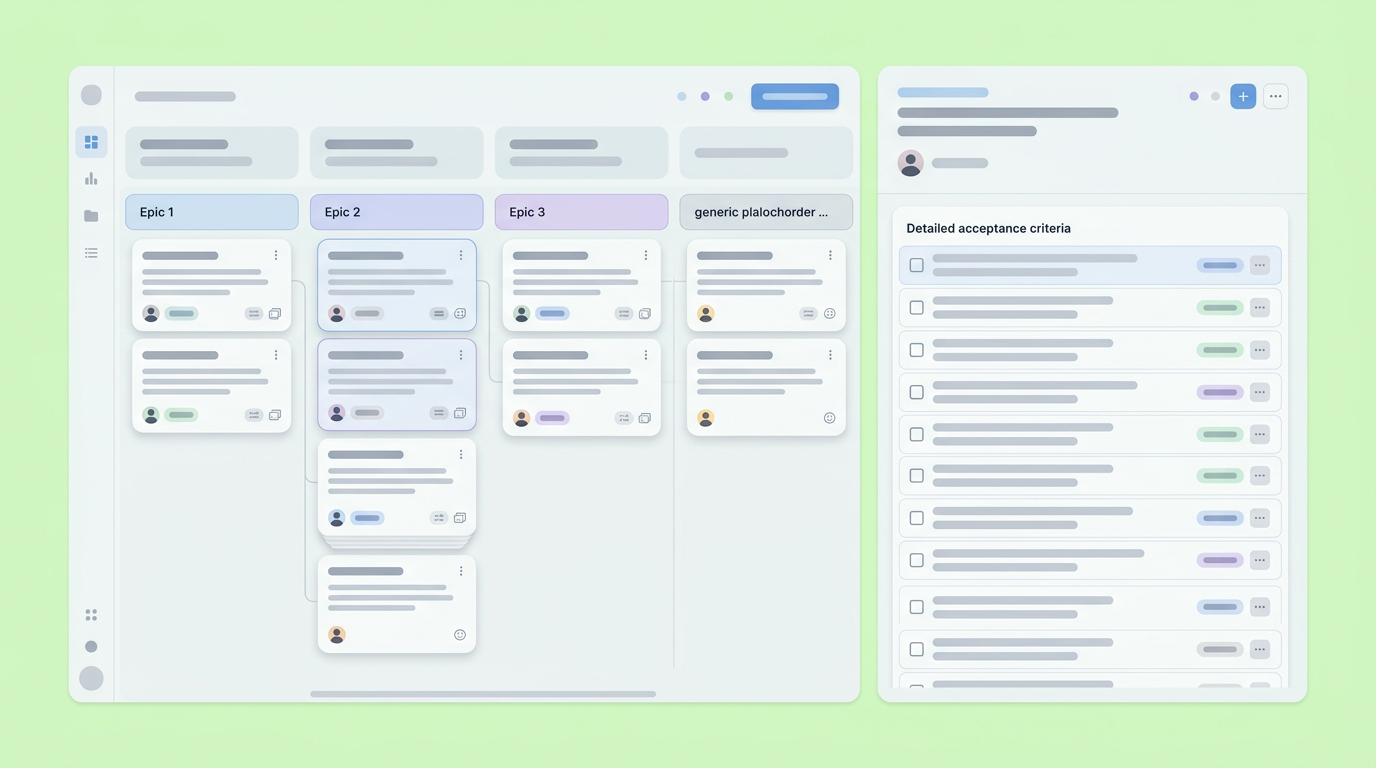
Visualizing these stories bridges the comprehension gap quickly. Connecting text-based stories to low-fidelity artifacts creates immediate recognition. Teams spend less time parsing grammar and more time understanding the intended workflow.
Establishing Context and Strategic Alignment
Providing deep business motivation anchors the entire engineering project and connects daily tasks to overarching company goals. When cross-functional partners understand the strategic objective, they make better independent decisions during the daily execution of the build.
Missing strategy creates disengaged output. Developers pull tickets, write code, and close issues without understanding how their work impacts retention or revenue. Documenting the strategic connection gives their daily labor clear meaning.
Leaders look for alignment across the business landscape. The spec functions as the translation layer between high-level company OKRs and granular shipping milestones.
Nailing the Problem Statement
The problem statement defines the customer pain point without suggesting any specific technical solution. It creates a defined target that allows engineering and design to brainstorm multiple creative approaches to resolve the friction.
This statistic appears unverifiable; 75% of projects fail due to set-up phase errors (BITKOM) or 70% of digital transformations miss objectives (McKinsey), but no Forbes source confirms 75% cross-functional friction. If the problem statement lacks clarity, the resulting solution will inherently miss the mark.
A strong problem description relies on verifiable user feedback or quantitative behavior data. We look for phrases that explain what the user is attempting to do and precisely what stops them from succeeding today. Grounding the issue in reality stops teams from debating personal preferences, a common source of frustration I've observed in many projects.
Defining Clear Acceptance Criteria
Acceptance criteria outline the specific conditions a feature must meet to be considered complete from a user perspective. They form a clear checklist that guides testing parameters and prevents endless feature tweaking.
The criteria remove subjective opinions from the approval process. You establish the exact states, error handling paths, and required data outputs that signal success.
Engineers use these criteria to structure their technical testing suites. Vague language creates gaps where bugs hide. Using precise, measurable parameters ensures everyone agrees on the definition of done before a single line of code goes into a production environment.
How AI Influences PRD Drafting Workflows
Generative AI assists product managers by translating scattered notes and transcribed interviews into structured text rapidly. LLMs synthesize qualitative data into standard document formats, freeing up time to focus heavily on strategic alignment and prototyping.
Aakash Gupta noted recently that the art of writing a Product Requirements Document has changed completely due to the sudden availability of advanced text synthesis tools. The blank page simply does not exist for product managers anymore.
The mechanical act of typing out requirements takes up a shocking amount of a PM schedule. Automating the early drafting stages lets teams elevate their focus toward validating assumptions rather than formatting tables.
Drafting Product Requirements Document Templates with LLMs
Starting with a standard product requirements document template generated by an AI model provides immediate structural scaffolding. Teams prompt systems with compiled user research to populate initial drafts instantly and push past initial creative blocks.
Evaluations covering 5 AI tools to write a PRD show that commercial chatbots excel at producing serviceable first drafts for internal updates. They gather disjointed Slack messages, customer call transcripts, and strategy memos, turning them into coherent paragraphs.
You review the generated content critically to ensure accuracy. The AI acts as a fast-typing assistant rather than an authoritative product leader. The output provides a structured canvas that the human product manager must refine, edit, and validate against reality.
Where Machine Generation Falls Short
AI text generation cannot replace the hard collaborative work of agreeing on scope tradeoffs. Models struggle heavily to validate whether a proposed solution actually fits within the specific technical constraints of a legacy codebase.
We consistently find that AI tools generate generic assumptions if not prompted with rich, specific context. A language model might write perfectly formatted acceptance criteria for an inventory tracking feature, completely unaware that the team's backend database lacks the necessary fields.
Relying entirely on generated text leaves dangerous ambiguity. Product requirements document best practices demand human validation and active negotiation with engineering leads. The machine can draft the initial proposal, but product managers secure the final team buy-in through active conversation. Common pitfalls to watch out for include:
- Lack of Domain-Specific Knowledge: AI may miss crucial industry nuances.
- Inaccurate Technical Constraints: AI doesn't understand your specific tech stack limitations.
- Ethical Considerations: AI outputs may reflect biases present in its training data.
The limitations highlight the invaluable role of human oversight and critical thinking in leveraging AI effectively.
Best Practices for Keeping Specs Grounded
Product requirements document best practices prioritize continuous visualization and active engineering feedback loops over static text. By embedding interactive elements and syncing issues directly to developer tools, the spec becomes a practical daily necessity.
When deciding how to define product requirements practically, documentation needs a tangible counterpart. Words fail to convey layout nuances or animation timing effectively across disciplines.
The most successful teams view their spec as an interactive directory. They link out to external resources, embed live data, and map tasks back to tracking boards. This interconnected approach keeps the document relevant long after the initial kickoff meeting concludes and supports features such as:
- Dynamic Updates: Ensuring all linked resources reflect the latest information.
- Traceability: Connecting requirements directly to design, development, and testing artifacts.
- Early Feedback: Facilitating continuous stakeholder engagement and validation.
Integrating Shared Prototypes
Connecting a shareable prototype directly within the documentation resolves persistent visual questions that text completely fails to capture. Interactive models show the exact user flow, ensuring product intent translates accurately to production code.
This specific McKinsey statistic is unverified in available sources; consider removing or replacing with 'Prototyping reduces rework' without a specific percentage unless verified. The visual layer removes guesswork. Engineers click through the intended experience rather than interpreting written descriptions of state changes.
Visual tools integrate deeply with the documentation process. Dazl is the PM's teammate from ideation and spec writing through a hand-off ready prototype, keeping the whole team aligned. By maintaining a single source of truth that pairs the written rules with the interactive model, teams ship exactly what they agreed upon. You can learn more about setting these expectations by reading What Is a Product Prototype? A Guide for Product Managers.
Managing State Workflows Across Jira and Linear
Specs must map clearly to issue tracking systems so developers can pull tickets without losing the broader strategic context. A well-constructed document links granular tasks back to the overarching user flow and state requirements cleanly.
This specific Atlassian statistic is unverified; PMI reports 37% cite inaccurate requirements as the primary failure cause, but no Atlassian source confirms 40% time spent on documentation updates. Disconnected workflows burn hours of valuable planning time on administrative syncing.
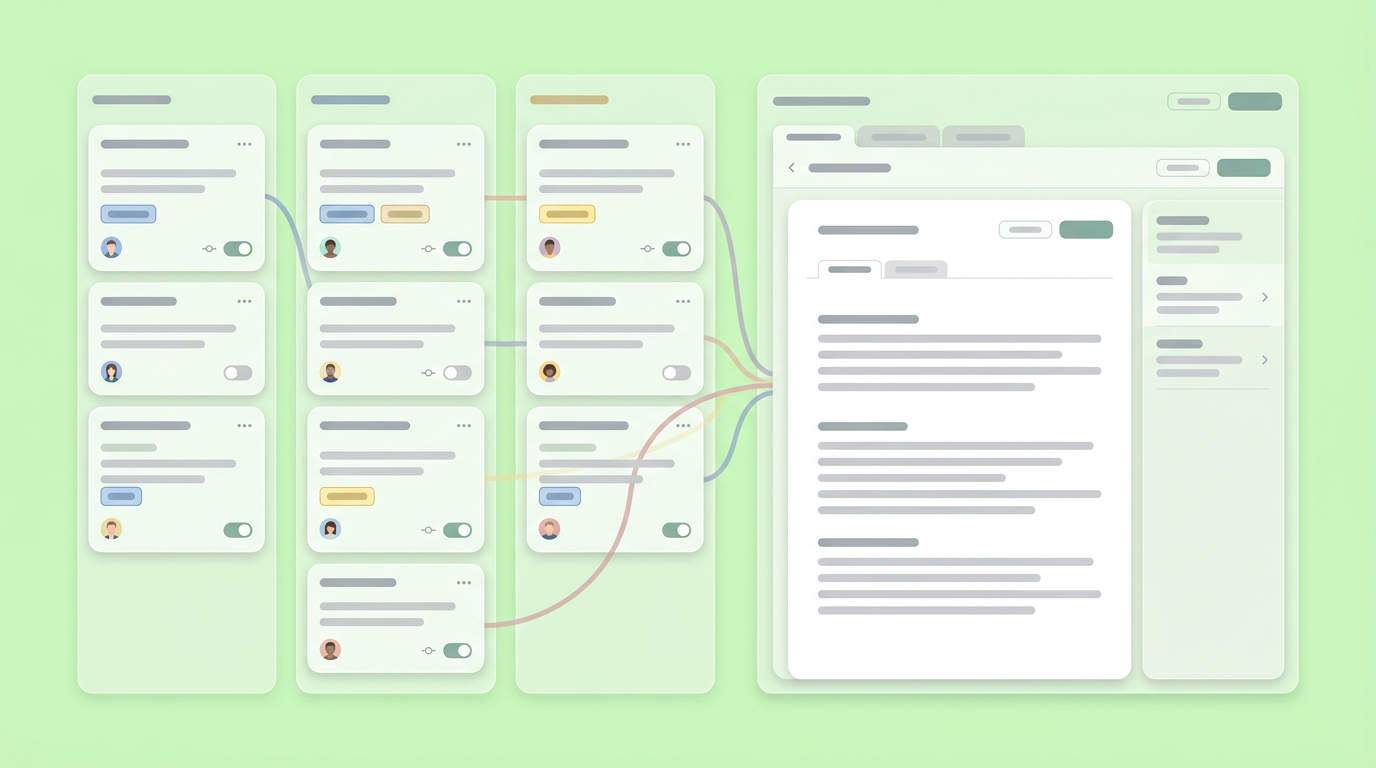
Modern teams embed their documentation directly into their ticket infrastructure. If an engineer updates a technical requirement on a Linear issue, that change must reflect in the primary PRD instantly. Maintaining this hygiene guarantees everyone operates on identical assumptions.
Bridging the Gap Between Text and Execution
Documentation practices will continue migrating away from static files toward connected workspace environments. The emphasis turns toward maintaining a continuous loop of shared context rather than shipping a single, perfect text document.
The boundaries separating the spec, the prototype, and the code repository continue to blur into a single continuous pipeline. Product managers who master this flow spend less time defending their requirements and spend more time refining the actual user experience based on real interactions.
Adopting an iterative mindset for your specs ensures they never slow the team down. You give engineering enough context to begin safely, provide the visual anchors to guide their architecture, and remain flexible as new constraints emerge during the development phase. Keeping the tools lightweight and the communication open prevents the dreaded scenario of shipping a perfectly documented feature that entirely misses the user problem.
You and your team can bring these living specifications to life by signing up for Dazl to start your trial.
Get Started