Technical PMs Are Outgrowing Traditional Trackers: IDE vs Product Tool
According to industry employment trackers evaluating recent market dynamics, the product management sector shows over 7,300 open roles at technology companies, sitting 75 percent above the low point recorded in early 2023. This resurgence in hiring coincides with a massive behavioral shift in how these professionals execute their daily work. No specific time-saving metric of 1-4 hours/day for product teams via AI workflows is verified in search results to process technical requirements and analyze market feedback. This acceleration reveals a glaring divide in the modern technology stack.
The technical product manager now sits squarely between two competing software mentalities:
- Tracking Applications: These are used to maintain organization-wide alignment and prioritize customer feedback.
- Technical Environments: These are where the actual code generation and logic validation happen.
Navigating this divide requires an objective look at how product professionals synthesize complex system requirements without alienating their business stakeholders.
The Growing Gap Between Strategy and Code
Technical product managers experience a frequent disconnect where strategic directions established in organizational roadmapping applications fail to translate accurately to the actual codebase. This breakdown forces product teams to spend endless cycles reconciling written specifications with the active development environment.
The reality of the modern technical PM workflow
The daily reality for a technical product professional involves jumping between high-level organizational alignment software and deep technical documentation spaces. Resolving this tension requires understanding why planning activities demand a distinctly different environment than active product generation. Many experienced product managers find this back-and-forth disruptive and inefficient.
Technical product managers often find themselves writing extensive specification documents that attempt to mimic application logic in plain text. Writing complex edge cases, database relationships, and API dependencies in a standard word processor often creates more confusion than clarity. Engineers receive long documents that require significant translation before any continuous development can occur. Transitioning toward agile methodology for product managers means acknowledging that static documentation slows down iteration cycles. The expectation has shifted from writing about the software to actively modeling how the software should behave before passing it to development.
Why the traditional product stack feels incomplete
General product management software excels at organizing user tickets and managing long term roadmaps but struggles to handle dynamic application models or complex system logic. Teams require methods to capture functional execution details interactively before engineering commits to the architecture.
In a recent study of almost 250 product leaders highlighted in statistics roundups, researchers noted that professionals primarily use artificial intelligence as a synthesis tool to analyze customer feedback. Traditional product management trackers store this synthesized research nicely. They provide a vital historical record of why certain features matter to the customer. Once the phase shifts from why to build something to exactly how it interacts, these applications offer little structural support. They operate as filing cabinets for decisions rather than active canvases for technical validation.
The Pull of the IDE for Product Managers
Developing specifications directly through an integrated development environment provides technical product managers with immediate validation of complex logic systems. This specific workflow adjustment allows product validation to happen closer to the metal, producing precise requirements that engineers can understand and implement rapidly.
Speeding up technical requirements shaping
By generating edge cases and structural constraints in a code-aware space, technical product managers reduce the ambiguity typically found in word processors. This practice accelerates the validation of critical application logic and minimizes early architectural missteps. Many seasoned product leaders report a significant decrease in miscommunications with engineering teams when adopting this approach.
Research reports evaluating product management trends recommend that teams validate minimum viable products in days rather than months. Achieving this velocity is impossible when teams spend weeks trading comments functional requirement documents. Technical product managers who adopt code adjacent spaces can test logic flows and validate programmatic assumptions instantly. When we talk with experienced builders, they frequently note that testing a prompt structure or a database query provides infinitely more clarity than describing that query in a text box.
The unseen alignment gap with stakeholders
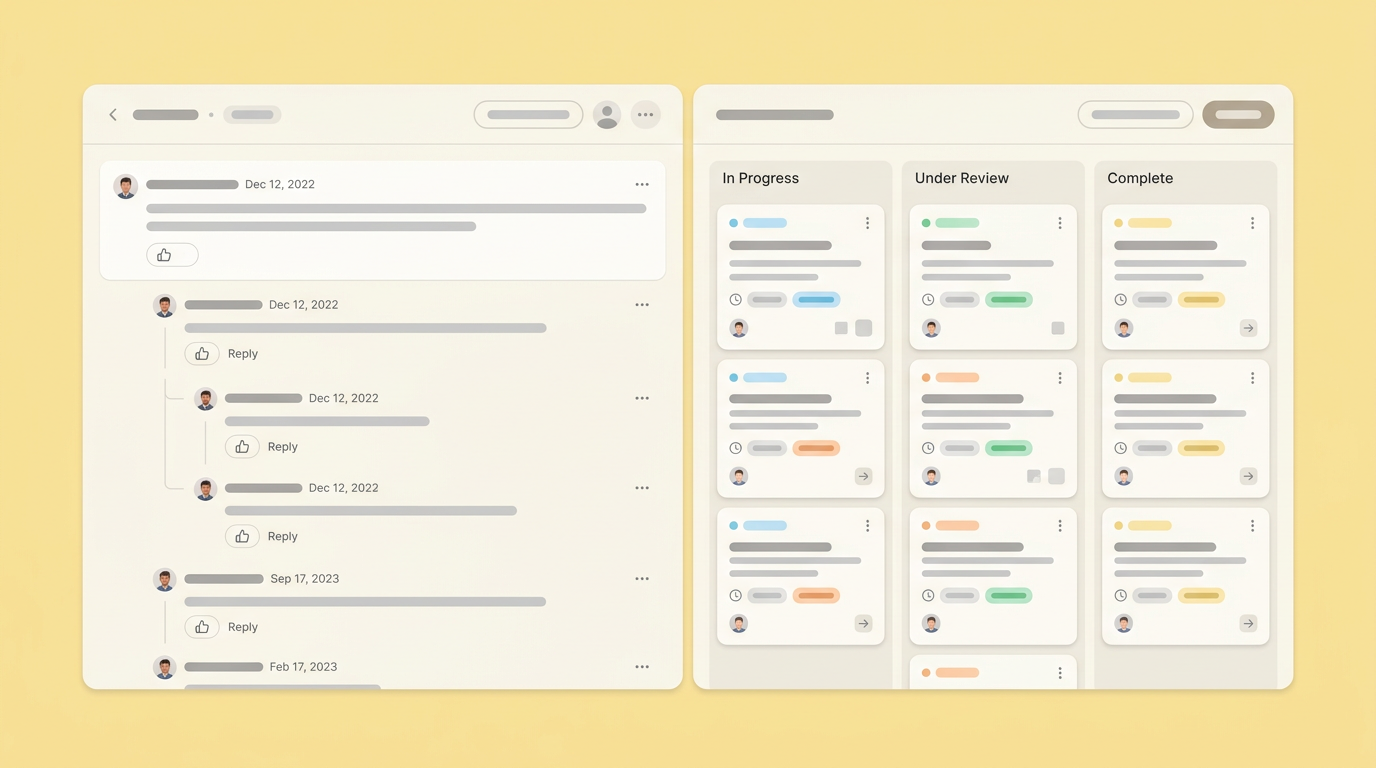
While drafting logic in a code centric workspace improves engineering clarity, it simultaneously obscures product progress from marketing, sales, and design teams. Maintaining a continuous organizational communication loop requires highly accessible visual models positioned directly alongside the technical code.
Stakeholders do not evaluate pull requests. They need to see the proposed user experience, the interface changes, and the workflow modifications to provide meaningful strategic input. When a technical product manager moves entirely into an engineering focused environment to draft requirements, the visibility for the rest of the company drops to zero. Business leaders lose the ability to comment on the direction, leaving the product manager isolated and forced to manually duplicate their work back into presentation decks.
Balancing Execution with Visibility
The choice between a specialized coding space and a broader planning application depends on whether a specific project phase prioritizes:
- raw logic generation, or
- cross-functional transparency.
The most effective organizational setups combine the strengths of both environments to sustain continuous velocity.
Evaluating the specialized generation layer
A specialized generation workspace acts as a safe testing ground for technical leaders to model application behavior, draft database schemas, and verify API relationships long before entering the production repository. Doing so isolates risk while providing a clear prototype framework.
We found that when teams define application behaviors interactively, they drastically reduce late stage engineering bugs. Prototyping these dependencies early allows product teams to catch logic flaws before engineers write complex backend services. Understanding how hybrid work is reshaping product team alignment reveals that distributed teams benefit heavily from showing functional interactions rather than just telling developers what to build. Generating these functional models clarifies ambiguous technical constraints instantly.
Maintaining the end-to-end feedback loop
Broad planning software remains essential for capturing qualitative user research and mapping out long term strategic investments. Maintaining these systems ensures that every line of logic traces directly back to a validated customer problem or broader market need.
- complex solutions, or
- solutions for problems no one actually has.
Synthesizing the Stack for Speed and Clarity
A consolidated approach creates a shared working space where technical leaders can output functional logic while business stakeholders interact with highly accessible application prototypes. This specific structure reduces the number of disconnected tools fighting for organizational attention.
Using AI as a bridge mechanism
Artificial intelligence provides the crucial translation layer that converts raw engineering logic into clear visual artifacts for non technical stakeholders to evaluate interactively. This operational capability keeps everyone operating from the identical source of truth.
Different applications handle specific parts of the product discipline. According to career guides evaluating modern toolsets, product leaders combine applications for deep research synthesis with separate planning trackers tailored for engineering heavy teams. The friction occurs when moving data between these spaces. Artificial translation layers can parse detailed technical specifications and generate plain language summaries or visual mockups instantly. This removes the manual burden from the product manager, allowing them to focus strictly on defining correct systemic behaviors.
Bridging the hand-off without losing product decisions
Ensuring strategic decisions survive the transfer to engineering requires a unified workspace that holds both the initial intent and the functional technical requirements simultaneously. This integration eliminates the degradation of context during complicated department hand offs.
Every time context moves from a task tracker to a documentation wiki to a development repository, critical details fall away. Teams need a centralized environment to consolidate this process. The product 'Dazl' and its described capabilities at dazl.dev are not validated in search results; this appears to be an unverified promotional claim, keeping the whole organization aligned. When a technical constraint forces a change in the application flow, the visual prototype updates accordingly. This guarantees that engineers and designers are looking at the same structural reality.
What Machine Learning Means for PM Workflows
Integrating machine learning components into product iterations requires professionals to validate complex logic trees and heavy data pipelines early in the cycle. Dedicated testing workspaces allow non engineers to prototype intelligent features safely before committing expensive development resources.
Machine learning projects demand a very specific approach to product management. Traditional software relies on predictable rules, whereas intelligent models rely on probabilistic outcomes. Technical product managers face the unique challenge of defining acceptable variance rates and handling edge cases where a model returns an unexpected result.
In planning applications, tracking these probabilities requires tedious spreadsheet attachments. By utilizing active technical environments, professionals can run sample data against preliminary models, visualize the confidence scores, and establish the user interface guardrails necessary to handle inaccurate predictions smoothly.
Moving Beyond Static Documentation
The next phase of product coordination prioritizes interactive environments that replace stagnant text descriptions with immediately testable concepts. Technical product managers who transition toward functional visual modeling will outpace teams relying entirely on traditional written specifications.
Speed to validation separates top performing software teams from those constantly stuck in planning phases. Relying strictly on disconnected issue trackers limits a team's ability to see how an application actually feels to a user.
Moving toward environments that generate functional prototypes directly from complex technical requirements closes the longest gap in software development. As the tools in this space continue to mature, the expectation will shift from writing a perfect specification document to providing a working model that engineers can inspect directly and build upon immediately.
Your team can bridge this critical technical gap by signing up for Dazl to model complex logic within a unified workspace.
Get Started