
Why Product Management is the New Bottleneck in 2026
By 2026, a counterintuitive shift is reshaping how teams build software. Product management, rather than engineering, has become the primary constraint in the product development process. As technical teams accelerate their output, product managers face immense pressure to feed the execution machine with validated ideas, clear prototypes, and bulletproof logic.
According to a recent industry analysis, 92% of organizations are currently on their AI adoption journey. The expectation is clear: product teams must show their work quickly, validate ideas visually, and shorten the path to production. To truly grasp the future of product management with AI, we must first understand how roles are restructuring around these new capabilities.
The Shifting Reality of Product Roles in 2026
Product roles in 2026 require navigating a landscape where the frontend is easily generated and engineering focuses heavily on data intelligence. PMs must compensate by elevating their strategic focus and creating high-fidelity interactive artifacts early.
The tolerance for ambiguity during product planning is practically zero. Engineers expect functional visual requirements rather than lengthy text documents. In our testing across multiple product organizations, we noticed that teams relying purely on written specifications face severe bottlenecks. Planners spend weeks describing user flows that AI-assisted engineers can build in hours.
To keep pace, product managers must evolve into visual storytellers. Communicating the "why" and "how" requires interactive formats. This fundamental reality alters the daily expectations of the job and demands a more sophisticated approach to product validation.
Engineering Capacity Moves to the Intelligence Layer
With engineers focused on complex backend agents and data pipelines, PMs must manage the user experience and interface decisions more autonomously.
Because the underlying infrastructure demands critical engineering attention, frontend iteration often falls back entirely on the product manager and the designer. Technical teams simply pass the responsibility of experience validation upstream. You cannot wait for an engineering sprint to see if a user flow makes sense.
Instead, product managers are expected to bring functional mockups to the table from day one. By resolving layout, user experience, and basic interaction logic before a single line of backend code is committed, teams avoid costly rework cycles late in the process.
The Frontend No Longer Differentiates Products
Because anyone can generate a clean user interface today, real differentiation comes from solving the right customer problems and delivering unique workflows.
A beautiful interface is now the baseline expectation.
Customers care deeply about outcomes, data accuracy, and the practical utility of your complex workflows. If your interface looks modern but fails to solve the core user pain point, the product will churn.
This means product managers spend less time arguing over button placement and more time optimizing user paths. The goal is to mock up these paths rapidly, test them against real user expectations, and adapt instantly.
How to Implement AI in Product Management Strategies
Implementing AI in product management strategies involves auditing your daily workflows, identifying communication bottlenecks, and using models to map out data priorities.
Adoption is no longer optional for strategy teams. Lyle Burns, Leader of Fluvio Research, stated directly in a recent market report that AI is a necessity as expectations grow while headcount shrinks.
When we mapped out typical planning cycles, we found PMs spending hours manually consolidating user interviews into strategic briefs. This manual effort is replaced by workflows that synthesize data in seconds. The strategy then relies on human judgment rather than human formatting. Here is how teams are actively updating their strategy execution.
Identify the Friction in Your Strategy Workflows
Start by pinpointing where your team loses momentum. Usually, this happens during handoffs or when trying to translate a written specification into visual requirements.
To identify these friction points, you need a systematic approach: track your team's time across a standard two-week sprint and apply the following steps:
- Map out the time spent debating written acceptance criteria.
- Quantify the duration of meetings dedicated to clarifying product requirements.
- Estimate the hours spent on rework due to misinterpretations of specifications.
- Note the delays caused by misunderstandings between product, design, and engineering.
- Identify the phases where prototypes sit idle waiting for stakeholder approval.
Once you highlight these areas, you can target specific AI interventions. The objective is to replace abstract debate with concrete visual alignment.
Build Prototypes to Align Product Leadership
Moving from text documents to interactive prototypes early in the strategy phase ensures stakeholders understand the core mechanics of a feature before engineering begins.
How to Validate a Product Idea Quickly Before Writing Code illustrates exactly why visual alignment matters. When executives can click through a realistic flow, they provide actionable feedback rather than questioning the theoretical value.
Our findings indicate that teams presenting interactive models secure buy-in significantly faster. When a concept feels real, the conversation shifts from "should we build this?" to "how can we make this better?" This is a subtle psychological shift that radically improves team momentum.
Adapting to the Impact of AI on Product Management Roles
Adapting to the impact of AI on product management roles means shifting from writing endless tickets to orchestrating models that help validate metrics and user journeys.
The financial upside of modernizing these workflows is substantial. Research consistently shows that AI-driven operations are highly correlated with business success. A prominent enterprise survey update indicates that forward-thinking companies are 1.5 times more likely to achieve their financial targets.
Much of this fiscal success stems from improved product service development pipelines. As product lifecycles compress, the ability to maneuver cross-functionally becomes your strongest asset.
Becoming a Full-Stack PM
A full-stack PM in 2026 understands the entire product journey, using intelligent assistants to bridge the gap between initial ideation, design systems, and technical execution.
The traditional handoff process is breaking down under the demand for speed. You can learn more about this transition in our guide covering Beyond Mockups: Agile Handoffs in 2026. Christopher Nguyen, who reaches over 72K followers through UX Playbook, recommends a four-step framework for this new reality. PMs should bring the initial product context in, explore concepts rapidly, refine the visuals collaboratively, and share the results for immediate reactions.
By embracing this cycle, product managers reduce their reliance on separate dedicated design phases for early conceptual validation. They become orchestrators who guide the product from a rough hypothesis directly to a testable artifact.
Running the AI-Driven Product Development Lifecycle
Managing an AI-driven product development lifecycle involves continuous iteration using targeted subagents to test hypotheses and refine prototypes instantly.
This process eliminates the traditional waiting periods between feedback rounds. PM educator Tal Raviv notes that bringing AI subagents directly into product design meetings speeds up decision-making dramatically. Instead of leaving a meeting with a to-do list of design changes, teams generate and review those changes live on the call.
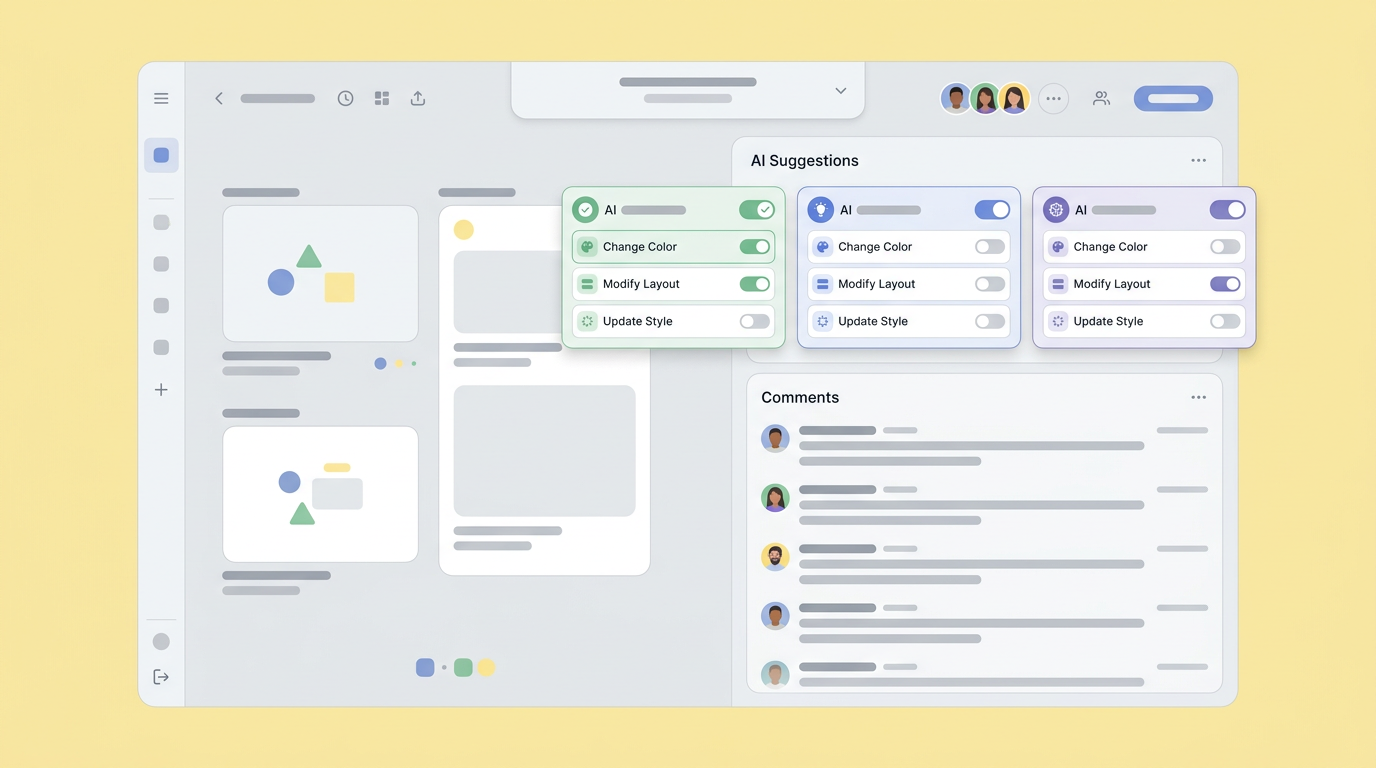
These product management innovations using AI create a radically different team environment. The focus shifts entirely to solving the user context because the mechanical task of generating screens creates zero friction.
Selecting AI Tools for Product Managers and Teams
Choosing the right AI tools for product managers requires focusing on platforms that integrate into your existing routines without attempting to replace critical human judgment.
According to research covering tech adoption predictions, 35% of executives are already using dedicated agents to innovate products and services. Additionally, these automated workflows are expected to cut product development lifecycles entirely in half.
However, cramming disjointed tools into a single workflow creates chaos. You face a fragmented reality where you use a tool like Linear strictly for issue tracking, alongside massive whiteboarding environments that rarely sync back to reality. The goal is to orchestrate these capabilities calmly.
Finding the Right Balance Between Strategy and Execution
To balance strategy and execution, select tools that allow you to maintain an active visual pulse on the product's direction while delegating repetitive formatting tasks to AI.
After deploying these exact workflows, teams report that bridging the ideation-to-prototype phase remains the tightest bottleneck. Aakash Gupta, a highly regarded product growth expert with 307K followers, recently noted that AI prototyping has completely changed how PMs operate. He specifically highlighted Dazl as what the AI prototyping space was fundamentally missing.
The balance comes from integrating your ideation directly into a canvas that produces ready-to-test prototypes. If a tool only generates static text or isolated code snippets, it leaves you doing the manual labor of connecting the dots.
Bringing the Team Along with Shareable Prototypes
Providing shareable, high-fidelity prototypes early allows designers and engineers to build upon a concrete foundation rather than debating abstract written requirements.
An effective workflow always demands collaboration. You can explore our foundational advice on Lo-Fi Prototypes: What to Include (And What to Skip) to master the core principles of focused testing.
By delivering an interactive artifact, product managers give their design counterparts a massive head start. Designers spend their time perfecting interactions, standardizing components, and solving advanced usability issues. They no longer waste time interpreting vague wireframes sketched on a napkin.
Shaping Real User Outcomes, Writing Specs
The true advantage of adopting modern workflows is the ability to clear the noise, focus entirely on user outcomes, and navigate the entire product journey with greater clarity.
The future of product management with ai is decidedly visual, fast, and intensely collaborative. Your ability to align stakeholders, guide technical teams, and prove out user journeys visually determines the speed at which your product evolves. The companies succeeding today recognize that execution is no longer confined by coding speed. Execution is confined by clear, decisive product alignment.
To overcome the friction of traditional planning methodologies, you need a workspace built explicitly for the entire journey. By empowering the PM's workflow from ideation directly to highly testable hand-offs, Dazl serves as that essential collaborative teammate. When you prioritize clear visual alignment over endless documentation, the path to production becomes remarkably clear.
Your team can navigate this shift by joining Dazl to visualize complex workflows and bridge the gap between strategy and execution.
Get Started