Generative AI for Product Designers: 2026 Workflow Playbook
This data highlights a stubborn reality in product management. Moving from a rough idea to an interactive experience requires translating abstract human logic into strict technical rules. Historically, trying to navigate that translation resulted in disjointed documentation and flat screens that failed to convey how a feature should actually feel. Generative AI for product designers changes this dynamic entirely, allowing teams to bypass static mockups and jump straight into functional exploration.
The Current State of AI Product Design Tools
The current state of AI product design tools reveals rapid adoption, with specialized prototyping and drafting workspaces replacing generic chat interfaces. Product teams now use these systems to iterate live, shifting the collective focus from drawing isolated flat pixels toward managing completely functional, interactive design systems.
The enterprise sector is heavily driving this structural shift in how teams operate. Product managers find themselves at the center of this investment, navigating a new era where ideas take shape instantly. We now have the infrastructure to test usability interactions in hours rather than weeks, keeping engineering efforts tightly focused on valid user flows.
Bridging the Gap Between Code and Canvas
Bridging the gap between code and canvas requires generative artificial intelligence tools that output interactive components rather than dead images. Modern product teams use these intelligent workspaces to visualize structural logic and state changes immediately, reducing translation errors between initial product requirements and final engineering work.
Traditionally, sending a static file link to an engineering team required a mountain of supplementary text to explain drop-down states, hover effects, and error handling. This gap between the visual canvas and the final codebase naturally caused friction in every sprint cycle. We found that shifting toward interactive, lo-fi prototypes inherently solves this communication problem by letting the interface do the talking. When developers can click through the exact user flow you envision, you eliminate the guesswork entirely.
The Market Reality: Who is Adopting AI Now?
Enterprise product development teams are leading AI adoption, moving rapidly from experimental use cases to fully integrated daily workflows. Research confirms that large organizations actively resourced generative methodologies over the last year, securing the internal commitment needed to train specialized models on proprietary design system constraints.
The growth trajectory is concrete and quantifiable for teams tracking these benchmarks. Product managers working inside these scaling organizations rely on artificial intelligence to maintain velocity without sacrificing usability standards.
Step 1: Using Generative AI in Product Development for Ideation
Ideation with generative AI in product development begins by translating raw market feedback into testable interaction flows. Product managers and design partners input specific user constraints into AI workspaces to rapidly generate multiple structural variations before committing to high-fidelity visual design.
Ideation is rarely a linear process. You start with customer interviews, market friction points, and business requirements. Before artificial intelligence stepped into the workspace, cataloging these inputs into a coherent wireframe took days of manual effort. Now, you can feed these exact parameters into a dedicated workspace to visualize fundamental layouts almost instantly. Scoping multiple structural variations on day one keeps the team completely focused on user logic rather than aesthetic debates.
Setting Up AI-Assisted Product Sketching
AI-assisted product sketching involves feeding product requirements into a model to produce low-fidelity structural layouts rapidly. This methodology prompts early, valuable dialogue about information architecture and user flow, ensuring the foundational logic remains sound before investing hours into detailed component styling.
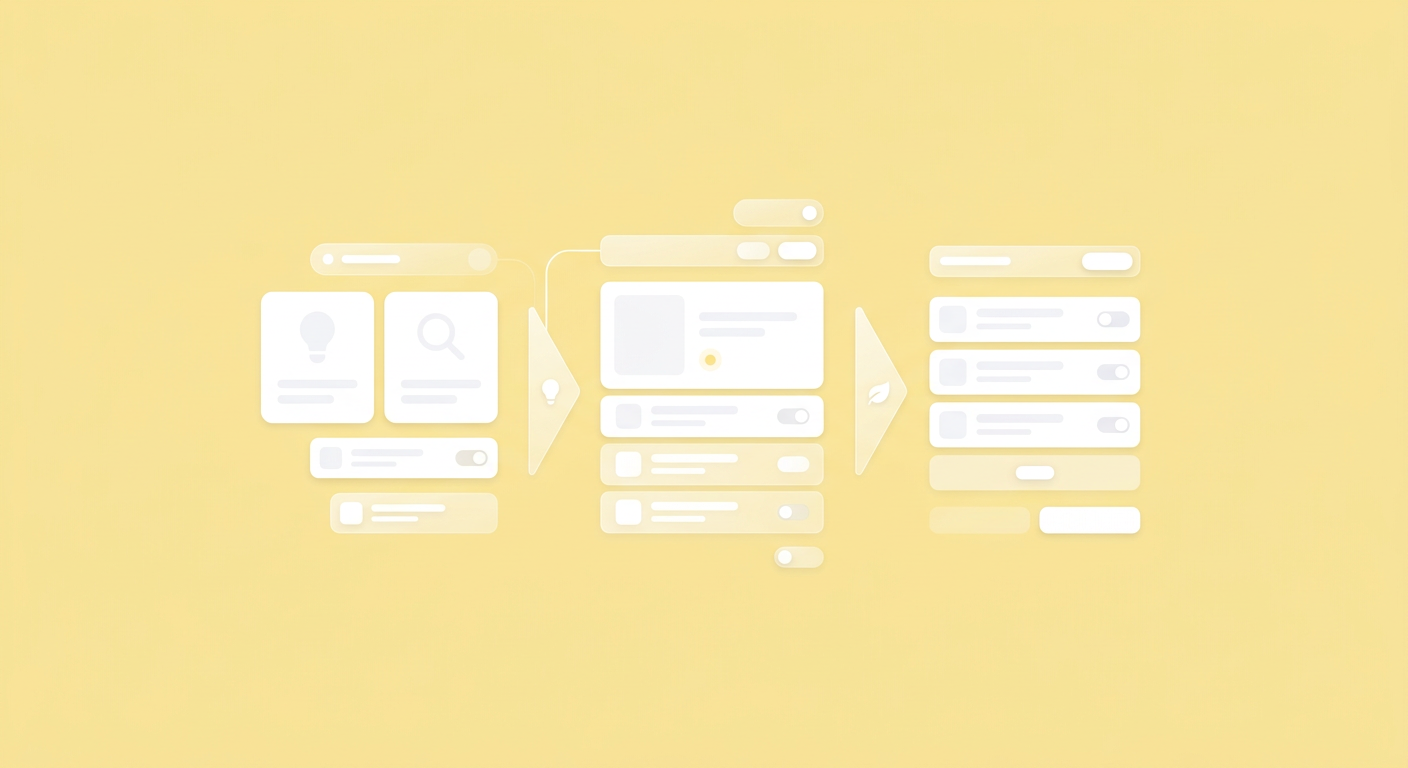
To use this workflow effectively, explicitly articulate your constraints to the system. For instance, you might instruct the workspace to draft a multi-step onboarding flow specifically optimized for mobile users preferring social logins. Christopher Nguyen regularly outlines a highly effective workflow context here, broken down into key steps:
- Bring in the product requirements.
- Rapidly explore broad ideas.
- Refine the visuals and interactions contextually.
- Share for immediate market reactions.
- Collect feedback efficiently.
- Iterate based on user insights.
The goal is to establish the bare bones of the experience so the entire team can react to a tangible structure.
Integrating Subagents for Research and Specs
Integrating subagents for research and specs allows product managers to automatically cross-reference historical user data with new feature proposals. These autonomous assistants work alongside the design team to highlight missing edge cases, ensuring the evolving prototype maintains strict alignment with overarching product strategy constraints.
Product educator Tal Raviv frequently explores the integration of artificial subagents directly into product design meetings for exactly this reason. By maintaining an active agent that strictly references past usability issues while the team actively sketches new views, you catch structural errors proactively. In our testing, we constantly rely on intelligent system prompts to challenge our baseline assumptions and enforce consistency across the broader user interface.
Step 2: Transitioning from Static Concepts to Interactive Realities
Transitioning from static concepts to interactive realities requires tools that translate flat wireframes into clickable, state-aware prototypes. This precise workflow eliminates the ambiguity of traditional handoff cycles by giving stakeholders a highly tangible experience of the product's fundamental functionality and responsive behaviors.
There is a distinct moment in every product journey where static links simply stop being enough. You cannot properly evaluate a complex data filtering dashboard by looking at a flat PNG file exported from a drawing tool. Transforming your initial ideas into interactive components guarantees that developers can see exactly how the application should handle null states, loading transitions, and user errors in real-time.
Applying Generative Design Software for Products
Applying generative design software for products involves utilizing AI platforms to construct functional component trees based on initial prompts. Teams feed specific usability rules into the system, generating highly modular interface elements that adapt natively to different screen sizes and active user states.
The financial commitment behind these specialized platforms demonstrates their rising value to modern businesses. Teams are investing heavily because interactive generative tooling directly accelerates their time-to-market.
Refining UX with Contextual Iteration
Refining UX with contextual iteration relies on conversational prompting to adjust specific interactions without rebuilding entire screen layouts. Product teams highlight isolated elements within a live prototype and instruct the AI workspace to modify state behaviors, dramatically tightening the feedback loop between conceptual design and execution.
When a stakeholder reviews a flow and requests a different navigation pattern, you no longer have to manually redraw twelve connected screens. By focusing on contextual iteration, you can selectively prompt the workspace to migrate a top-navigation bar into a collapsible sidebar, automatically updating the responsive rules across the entire prototype. We find this granular control helps maintain momentum during critical review phases, keeping everyone focused on the solution rather than the labor required to update the visuals.
Step 3: Aligning the Team Before Development Handoff
Aligning the team before development handoff necessitates sharing functional prototypes rather than extensive written documentation. Visualizing the product exactly as it will behave ensures engineering, product, and leadership stakeholders all agree on the precise mechanics of the targeted user experience.
There are few administrative tasks more prone to misalignment than dropping a massive, text-heavy requirements document into a Jira ticket and hoping the engineering team interprets it perfectly. Functional prototypes act as the ultimate source of truth, establishing an interactive baseline that words simply cannot deliver. When you fix the broken design to development handoff process, you drastically reduce sprint turbulence and unnecessary code refactoring.
Running Design Reviews with AI Prototypes
Running design reviews with AI prototypes allows teams to critique live interactions instead of conceptual sketches. Evaluating functioning navigation and data entry states ensures that technical constraints and complex usability issues are successfully identified long before any expensive engineering resources are actively committed.
When the entire project team sits down to review an upcoming sprint, clicking through a functional prototype provides instant clarity. Aakash Gupta recently noted perfectly that AI prototyping has completely changed how product management operates, observing that Dazl provides exactly "what AI prototyping was missing" because it delivers truly interactive assets rather than static pictorial generations. You can test actual data inputs during the review, ensuring the logic holds up to real-world scrutiny.
Securing Stakeholder Buy-In
Securing stakeholder buy-in involves presenting interactive models that executives can actively touch and test on their own respective devices. This tactile experience effectively bypasses theoretical debates about user workflows, replacing abstract arguments with concrete proof that the proposed fundamental solution effectively solves the target problem.
Leadership teams appreciate clarity above all else. When you provide them with a working prototype that they can navigate themselves, you win stakeholder support much faster than presenting a slide deck filled with bullet points. They experience the exact journey the customer will take, fostering an immediate, intuitive understanding of the product strategy and the value it aims to deliver to the broader market. This direct interaction significantly enhances empathy and commitment among stakeholders.

Rethinking the 2026 Prototyping Workflow
Shaping the 2026 prototyping workflow requires adopting smart tools that prioritize team alignment through interactive, hand-off ready artifacts. Product managers must strategically step away from disconnected planning documents and embrace new workspaces that keep every discipline focused on an accurate, working functional model.
Adopting generative AI for product designers isn't about attempting to replace human creativity or strict strategic thinking. It is ultimately about severely compressing the time required to convey a complex interaction accurately to the people building it. You eliminate the ambiguity that historically plagued software development by providing interactive context from the very first day. Founded by Wix co-founder Nadav Abrahami, Dazl functions as the critical daily teammate throughout this exact journey - guiding teams from raw ideation and spec writing directly to a hand-off ready prototype. Give Dazl a look the next time you need to show your team an idea rather than just writing about it.
Your team can modernize its rapid prototyping process by signing up for Dazl to turn your 2026 workflow concepts into reality.
Get Started