Mapping 2026 Generative AI Use Cases for Product Teams
You sit down with your engineering lead for the Tuesday sprint planning, armed with a carefully formatted requirements document, only to realize the core logic flow is still buried in text. The engineers ask for a visual representation of the new user onboarding flow. Your design team relies on a two-week sprint cycle, meaning that visual mockup will not arrive in time for this week's technical scoping. This exact friction point highlights why product managers are adopting new methods to communicate ideas visually and quickly.
Generative AI is shifting how product teams operate by providing immediate translations from abstract text to testable concepts. The goal is no longer just writing better documentation. The focus is now on generating artifacts that align cross-functional teams earlier in the process.
The State of Generative AI Use Cases in Business
Generative AI use cases in business now span code generation, automated data analysis, adaptive design, and automated research workflows. Application layer tools represent the largest share of this spending, allowing teams to generate tangible assets directly from project specifications.
Measuring the Growth in Product Development
The conversation around generative AI in product workflows centers heavily on adoption speed.
Our own teams have observed this shift firsthand. When tracking our product discovery sprints, we found that teams natively using AI tools iterate through validation cycles much faster.
Capital Pushing Toward Tangible Outputs
The enterprise market has moved past experimental chat interfaces.
This investment trickles down directly into product management. When engineers use AI for code generation, product managers need AI tools that can keep pace with that output speed. You cannot feed traditional, static PRDs into a rapid coding environment and expect the team to remain aligned. Interactive prototypes and structured design components become the necessary currency of a modern sprint.
Moving From Experimental to Essential
The speed of this transition remains remarkable. The researchers noted that these tools have gone from experimental to essential in record time, permanently altering how baseline product requirements are established.
5 Practical Generative AI Use Cases in Product
Core use cases of AI in product development include:
- Ideation research
- Generating text for PRDs
- Building interactive prototypes
- Optimizing physical or digital component design
Product teams rely on these applications to reduce the time spent bridging strategy and execution.
1. Market Research and Ideation Validation
Before a feature reaches the backlog, product managers spend significant time processing user qualitative data. You can compile thousands of user support tickets, feature requests, and market surveys into concise thematic summaries. This ensures that the early discovery phase is backed by aggregated data rather than isolated user anecdotes.
2. Generative Adaptive Product Design
Physical manufacturing and digital architecture are both utilizing generative models for efficiency. A detailed generative AI enterprise case study outlines how adaptive product design rapidly generates design iterations, significantly reducing time-to-market.
In the automotive sector, DigitalOcean reports that General Motors utilizes these algorithms to optimize part geometries for lighter vehicle components. This practice reduces physical prototyping costs and manufacturing errors, illustrating a principle that applies perfectly to software. Generating multiple iterations of a digital component allows product teams to test various user paths before committing engineering resources.
3. Creating Context-Rich Project Documentation
Writing a PRD traditionally takes days of formatting and organizing thoughts. Product managers now use contextual generation tools to expand bullet points into standardized, readable documentation. Drafting the repetitive parts of technical requirements allows more focus on feature strategy. If you are interested in modernizing this process, consider Creating a Dynamic PRD in 2026: A Blueprint for Product Teams.
4. Interactive Prototype Generation
The most concrete friction point for a PM is translating a text-heavy PRD into something visual. Christopher Nguyen, formerly of Google and now a leading voice in AI product design, outlines an effective workflow for this. He demonstrates how bringing the product context into an environment allows for exploration of ideas, refinement of visual interactions, and immediate sharing for reactions.
5. Standardizing Cross-Functional Handoffs
Every handoff between product, design, and engineering carries the risk of misinterpretation. In our own testing phases, we noticed that visual aids generated directly from the PRD maintain the original intent much better than translated summaries. Teams use AI to extract acceptance criteria directly from interactive mockups. This ensures that QA and engineering are evaluating the exact parameters the product manager created.
Navigating the Workflow Friction in 2026
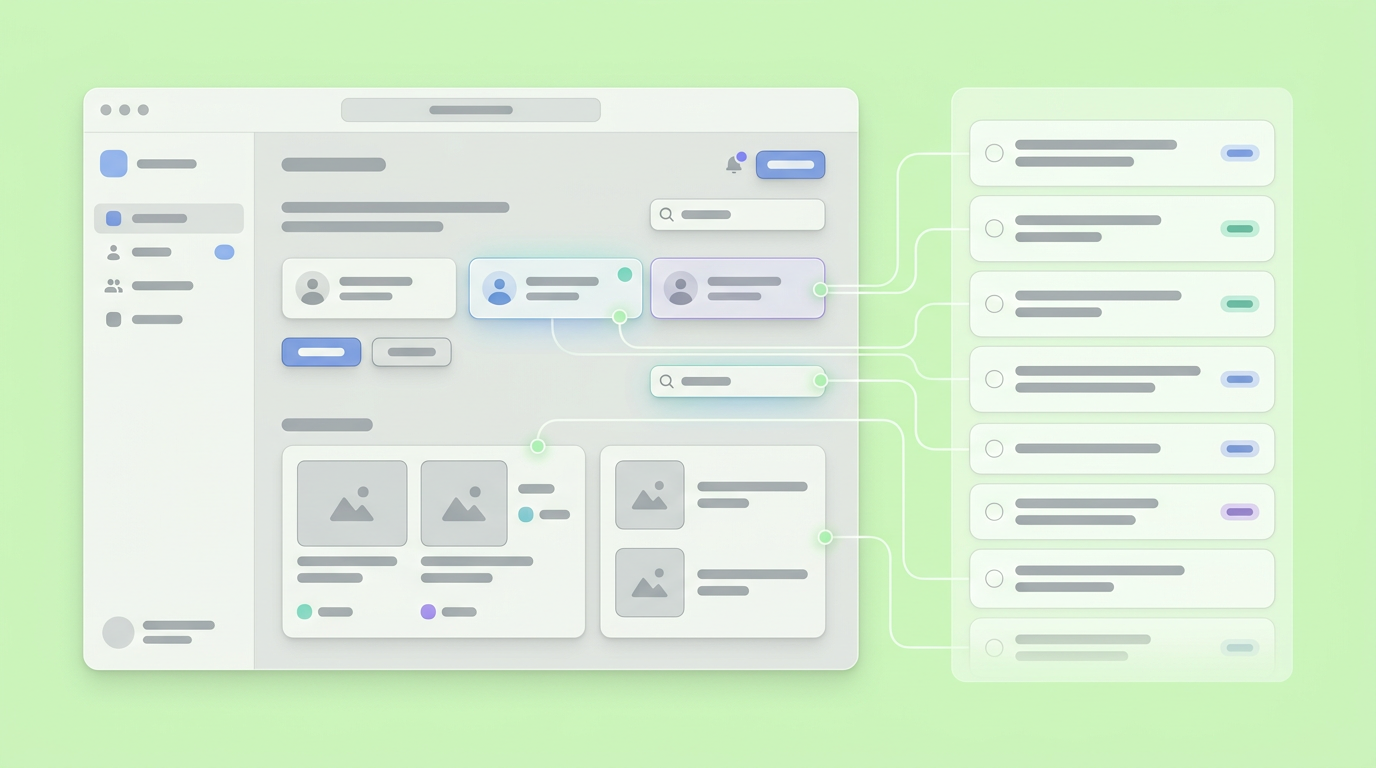
Product managers face friction when combining multiple disjointed generative tools, resulting in lost context between the ideation phase and the final engineering handoff. Addressing this fragmentation requires adopting platforms that connect the entire discovery logic.
The Cost of Fragmented Context
Moving a concept through four different specialized tools introduces massive workflow friction. You might use:
- One tool for summarizing user feedback
- Another for drafting documentation
- A completely separate environment for wireframes
The context degrades with every copy-and-paste action. Finding ways to unify these stops is highly recommended, as covered further in Evaluating 2026 Design Handoff Workflows.
Keeping Focus on Validating Logic
Visual fidelity should never mask poor product logic. When AI creates highly polished visuals instantly, teams might assume the underlying user journey is sound. Experienced builders know that a pretty interface cannot fix broken navigation.
Your tools must allow you to test how variables change when a user clicks a button, submits a form, or triggers an error. Tal Raviv, a distinguished professor at Tel Aviv University and a consultant for several leading tech firms, explored this exact requirement in a recent curriculum. He demonstrated incorporating AI subagents into design meetings specifically to pressure-test the logic of a proposed feature before it advances in the sprint.
Moving From Static Ideas to Testable Output
To validate product mechanics efficiently, teams are shifting from static wireframes to AI-generated interactive experiences that test real user logic early in the cycle. The goal is accelerating the timeline from a raw idea to a shareable prototype.
Shorter Paths to Internal Alignment
When you present a static flowchart to an engineering team, they have to imagine the transitions. When you present an interactive prototype that demonstrates the exact state changes, the conversation dramatically shifts. You stop debating:
- The theoretical user experience
- API limits and data structures
Ultimately, this level of clarity removes an entire cycle of back-and-forth questioning between departments.
Protecting the PM and Designer Relationship
The integration of these tools into daily workflows frequently raises questions about role overlap. A strong generation tool does not remove the need for specialized design systems. Instead, it allows a product manager to hand over a working interaction model rather than a blank page. The designer can then apply brand systems, accessibility standards, and advanced micro-interactions without having to guess the foundational mechanics.
For a deeper look into this collaborative process, refer to Generative AI for Product Designers: 2026 Workflow Playbook.
Shaping the Next Generation of Product Discovery
The way product teams plan and execute features relies on moving quickly from assumptions to observable artifacts. Generative capabilities have advanced beyond assisting with rough text drafts. The current methodology centers on creating tangible, interactive assets that force constructive team conversations earlier in the timeline.
Every successful sprint depends on shared context. The next time you sit down to bridge the gap between abstract requirements and a build-ready specification, consider integrating workflows that keep the entire team visually aligned. Platforms like Dazl provide the environment needed to convert written strategy into a testable reality.
Your team can explore these evolving workflows and accelerate your product development cycle by creating a free account with Dazl.
Get Started